Performance art and performance gender
A double review focusing on gender in two local exhibitions. Plus, updates relevant to previous topics.
Kathryn Munn | The Weeping Place
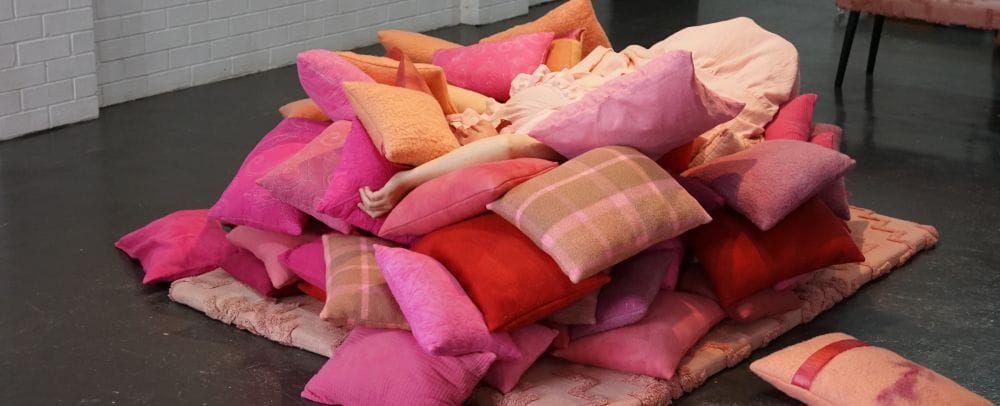
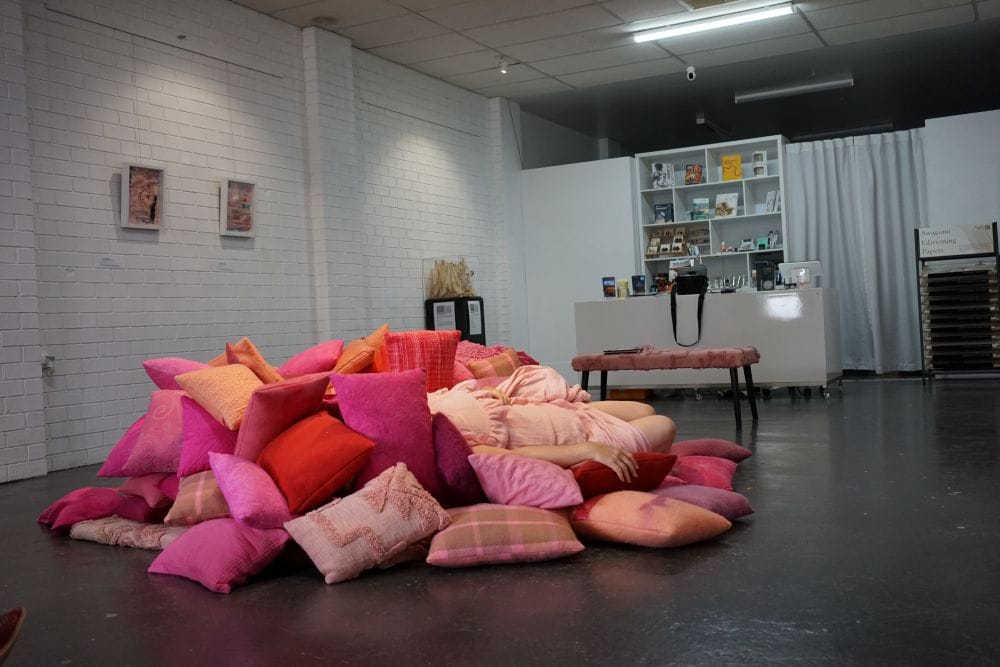
The artist rearranges cushions while a monthly farmers market bustles outside. Sounds seep in while she repositions numerous pink rectangles in multiple shades on a thin mattress in the centre of the gallery. There are oranges, dark pinks, light pinks, all looking very handmade and (it turns out) hand died, in an array of the most feminine shade. The fabric is that strong wool blanket, sometimes with plaid checks, other times just solid, that you remember from your nan’s couch. It can be scratchy but it’s always warm.
What does performance look like when you’re giving yourself permission to feel your full emotions without judgement? Making the invisible visible seems to be one challenge that Kathryn Munn faces in this performance titled Moisturise, part of her exhibition The Weeping Place at Workspace 3496 +Gallery.
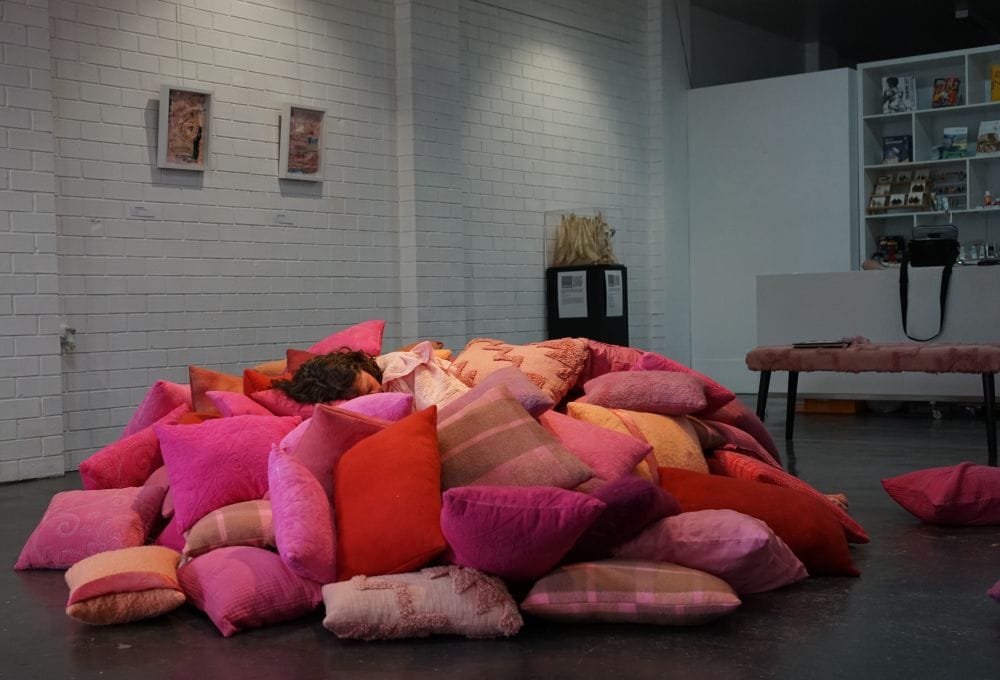
Conveniently I sat down at the what might be the start of one of the performance cycles on the day of the exhibition’s opening. Small town galleries need to tie their events to when the crowds are in town, and the monthly Sunday market—and the early summer sun—have brought the usual crowds to buy veggies and hot jam doughnuts.
I just sit observing, looking slowly at a woman seeking to express her inner world through a combination of movement, textiles and the creation of tension with the audience. The exact emotions are left for us to surmise. We can read on the wall that the artist has reached a point in her life where, with children grown, she can return to an art practice she began at the Sydney College of Art in 2001 and give expression to lived experience of chronic illness.
The rearranging is rhythmical. When the pile is about five cushions high, Munn tests the sturdiness and finishes adding extra pillows to the outer edges. A passerby announces their intention to run and jump on the pile. More cushions are placed as more audience members walk in, I think of them as market goers, transitioning to art consumers. I’m unaware but many are family, including Munn’s daughter documenting her mum’s performance.
When satisfied with the arrangement the artist sinks into the cushion mountain, her wriggling, sending pink shapes sliding across the floor. Wearing a pink dress and being slowly obscured by the shapes means, from my vantage, that Munn is almost all obscured by a sea of pinks, reds and oranges. I see an arm, a leg, some brown curly hair.
Part of the tension comes from Munn’s ignoring of the audience and the durational nature of the work which the audience commits to witnessing.
The experience of watching someone use a public space to process complex emotions creates an instant tension between how much time an audience might want to give and what the pay off will be for their investment. But a transactional approach is rarely useful for art audiences.
As she arises, Munn looks back at the pile of cushions, now rearranged by her subtle movements. Climbing into the centre she actively buries herself; many cushions scatter. She moves among the shapes, resting in one pose before adopting another, more and more submerged beneath the pink shapes. I’m reminded of the name of this exhibition—The Weeping Place—and the comfort intended from wool blankets, their ability to conjure the handmade pasts of our mothers/grandmothers/great grandmothers. Not a synthetic fibre in sight and not a fake emotion either, in spite of the fact that this is a performance.
I find myself enjoying the way Munn has chosen to make her interior struggles visible through a medium usually bound up with a level of artifice. The very word performance suggests a construct, putting something on. The audience are instead left to work out whether the emotions are real or not. Where the artist’s purpose and feelings are authentic or not. Visibly it doesn’t look like there are any emotions, and only when speaking at the official opening of the exhibition, do tears appear. Munn reflects that she’d hoped those tears would come out in the work, but instead they flow when she’s asked what the work means.
Kerrie Giddings | Her Patterns
Performing femininity also features in another local exhibition: Her Patterns by Kerrie Giddings at Mildura Arts Centre.
Themes of artifice and the expectations placed on women by patriarchal society are more explicitly dealt with here, though I experienced much less of the provocative tension created by Munn’s performance.
Giddings uses wallpaper from the 1950s to ‘70s to construct the identities of her subjects. In a single room, this exhibition is composed of images of women with a clear nod to the past and the synergies between retro aesthetics and female identity. The bright florals we know from those decades are repurposed, alongside some stunning vintage picture frames. These made me wonder about the extent of women’s domestic confinement and their ornamentality. I couldn’t get past the idea of wallpaper as a synonym for beauty standards placed on women at the time. This was underscored by a large vitrine in the centre of the room which displayed wall papering tools and samples, alongside a vintage women’s magazine replete with anti-aging advert.
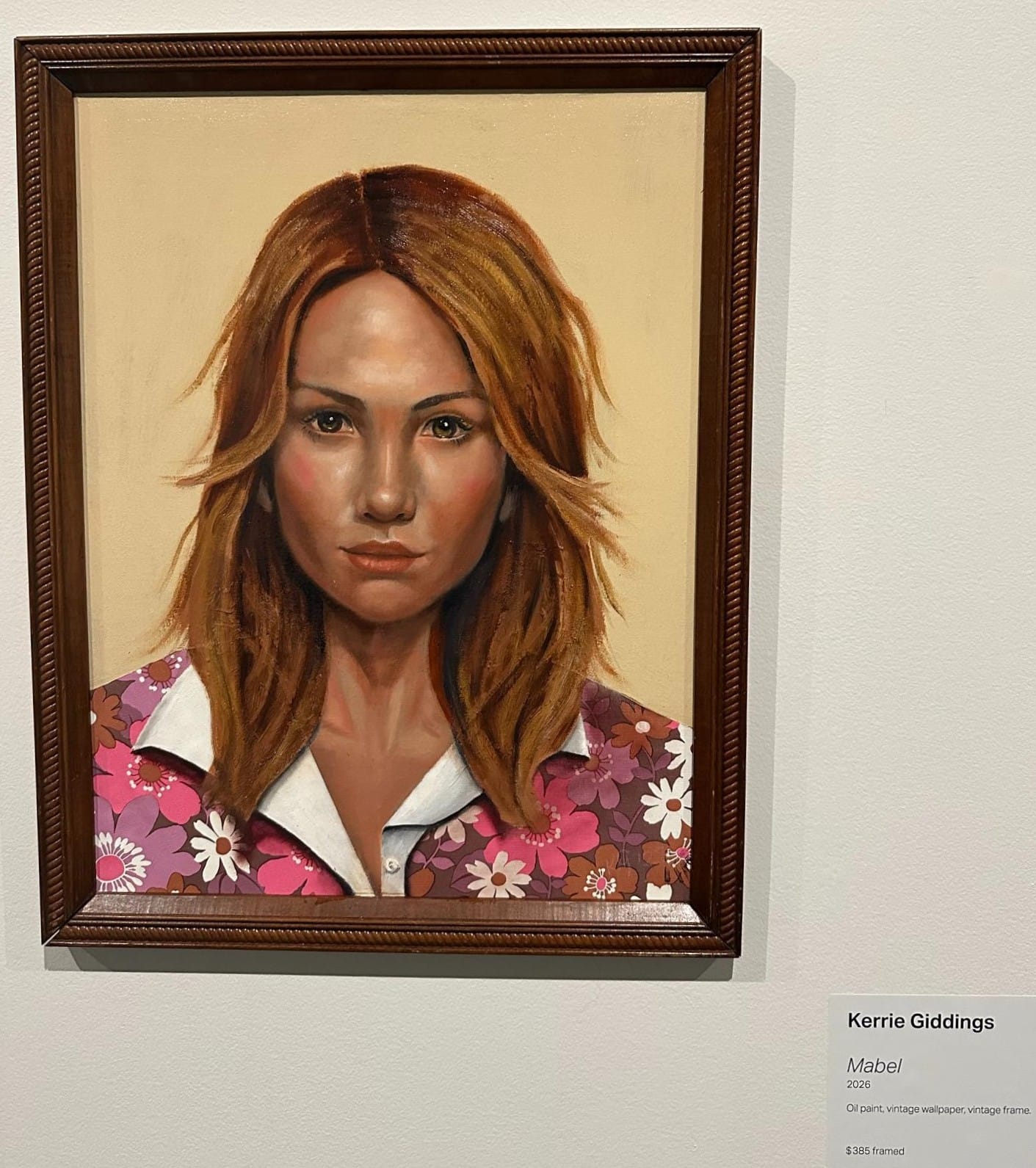
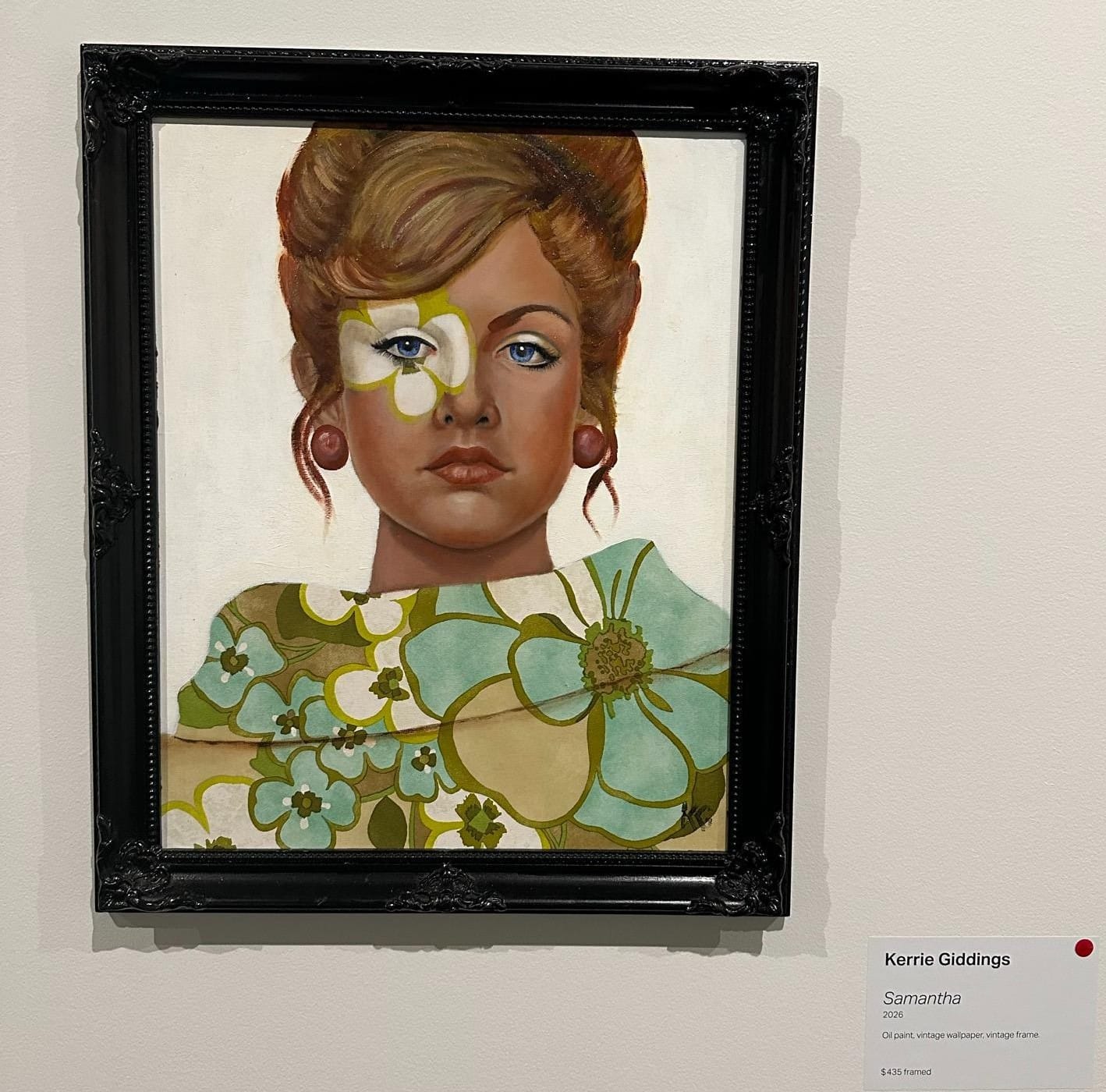
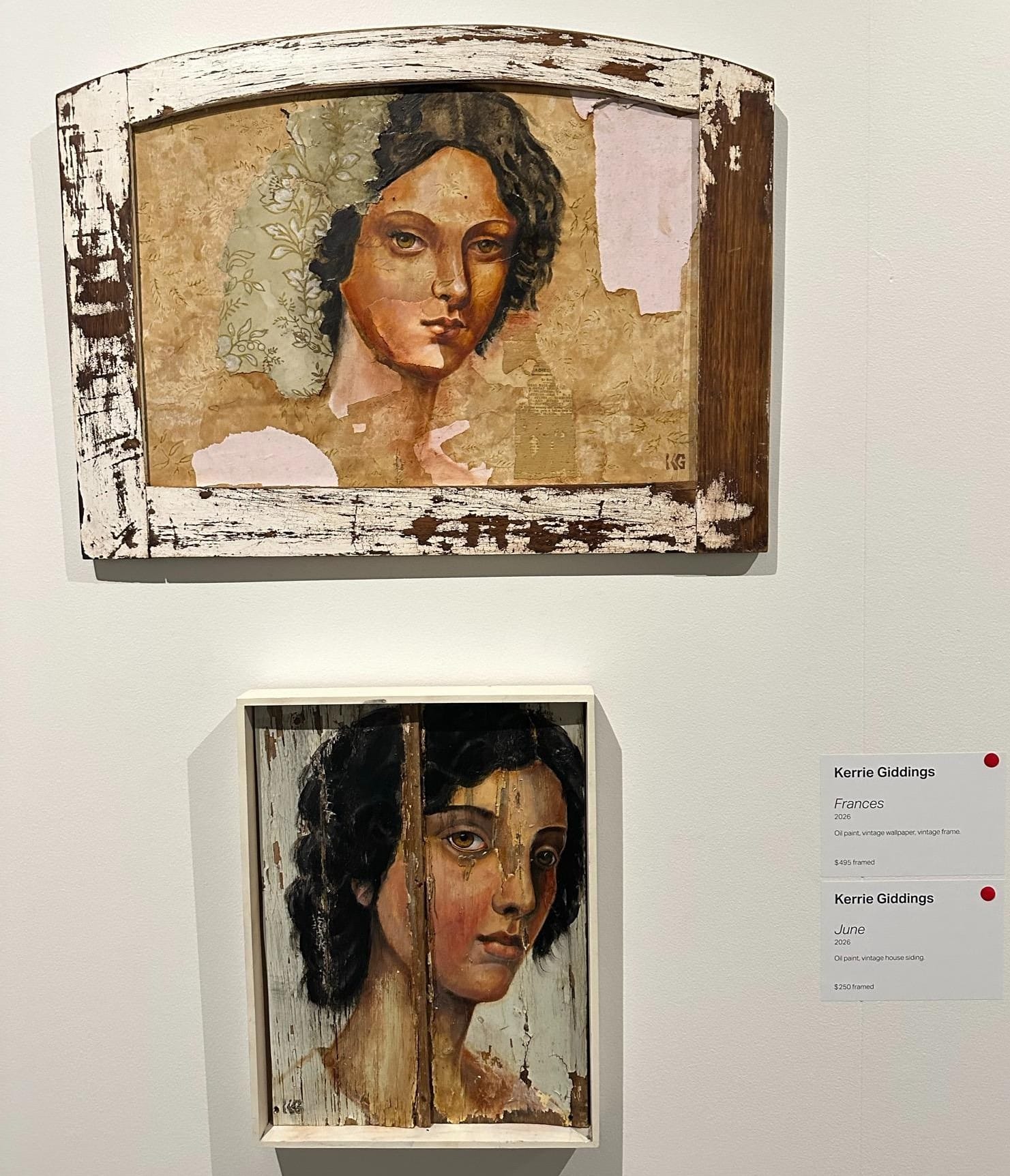
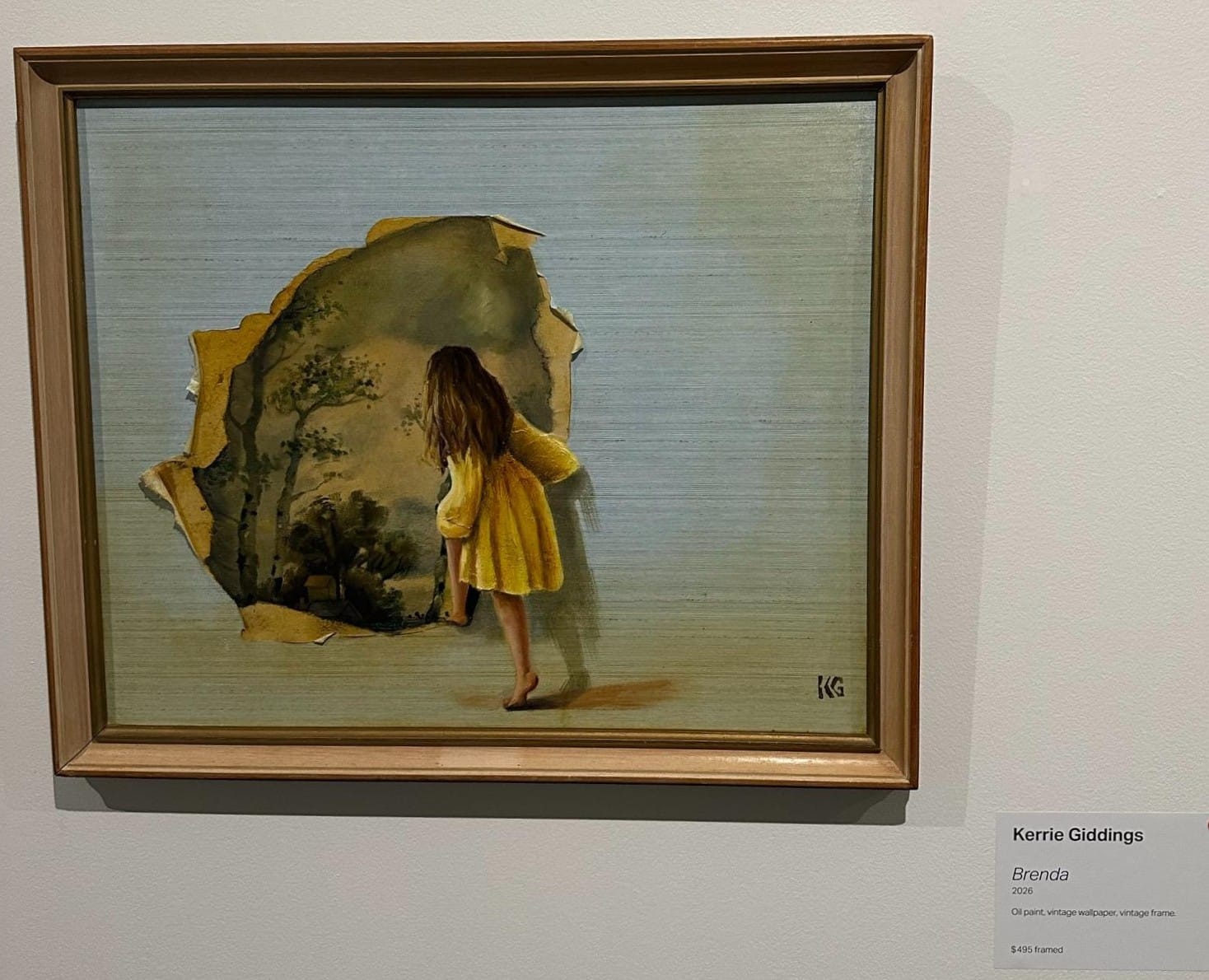
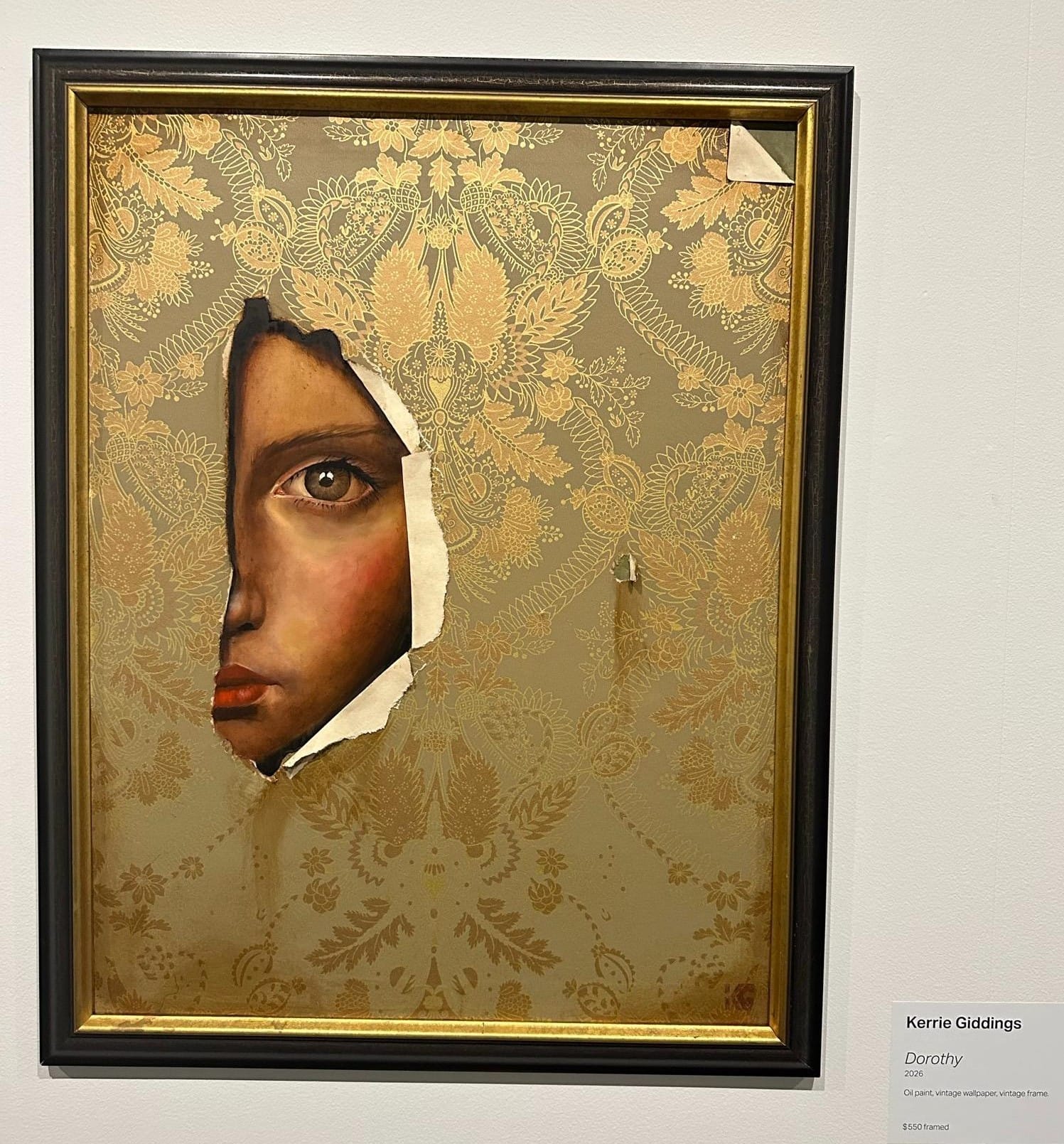
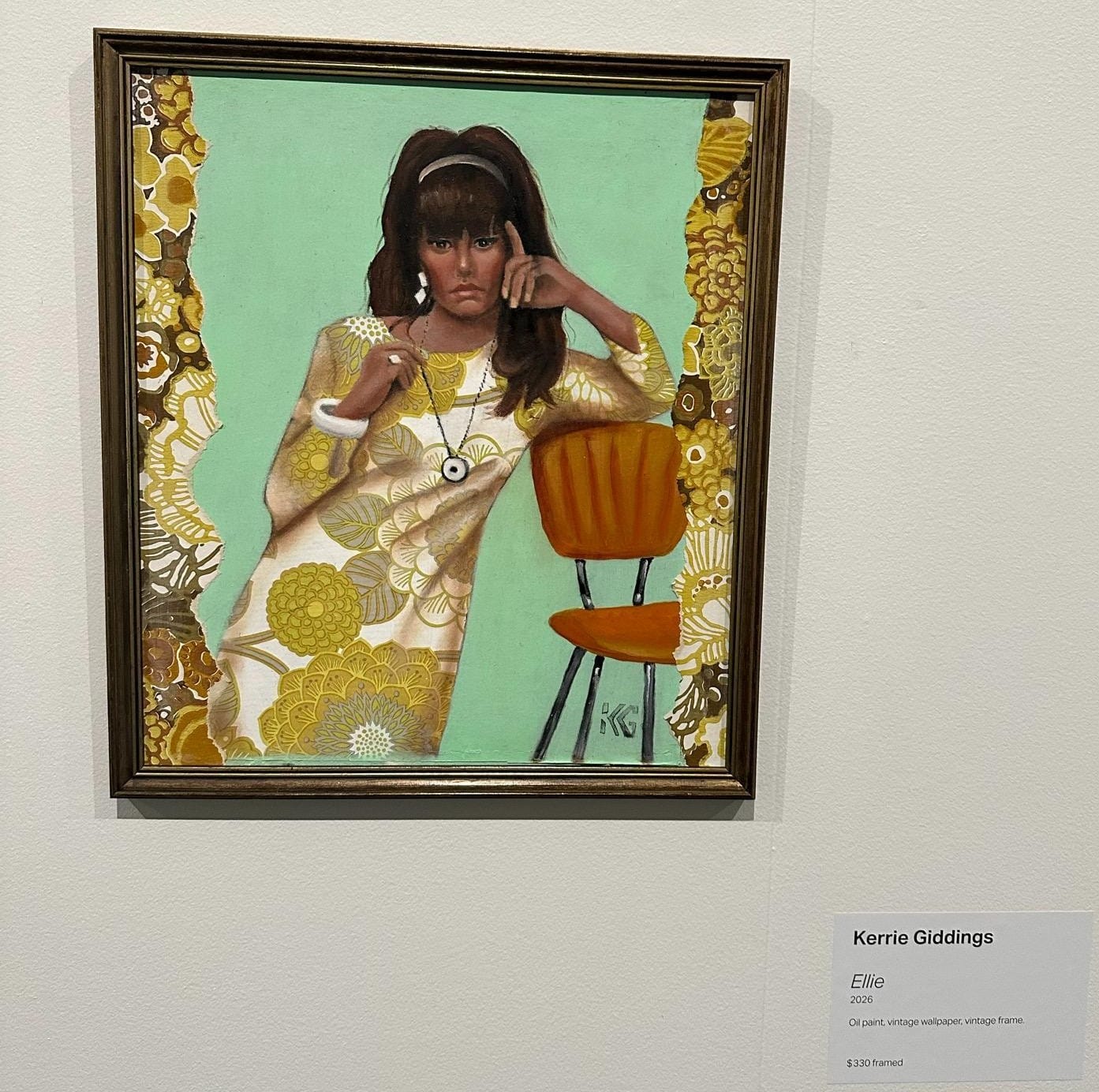
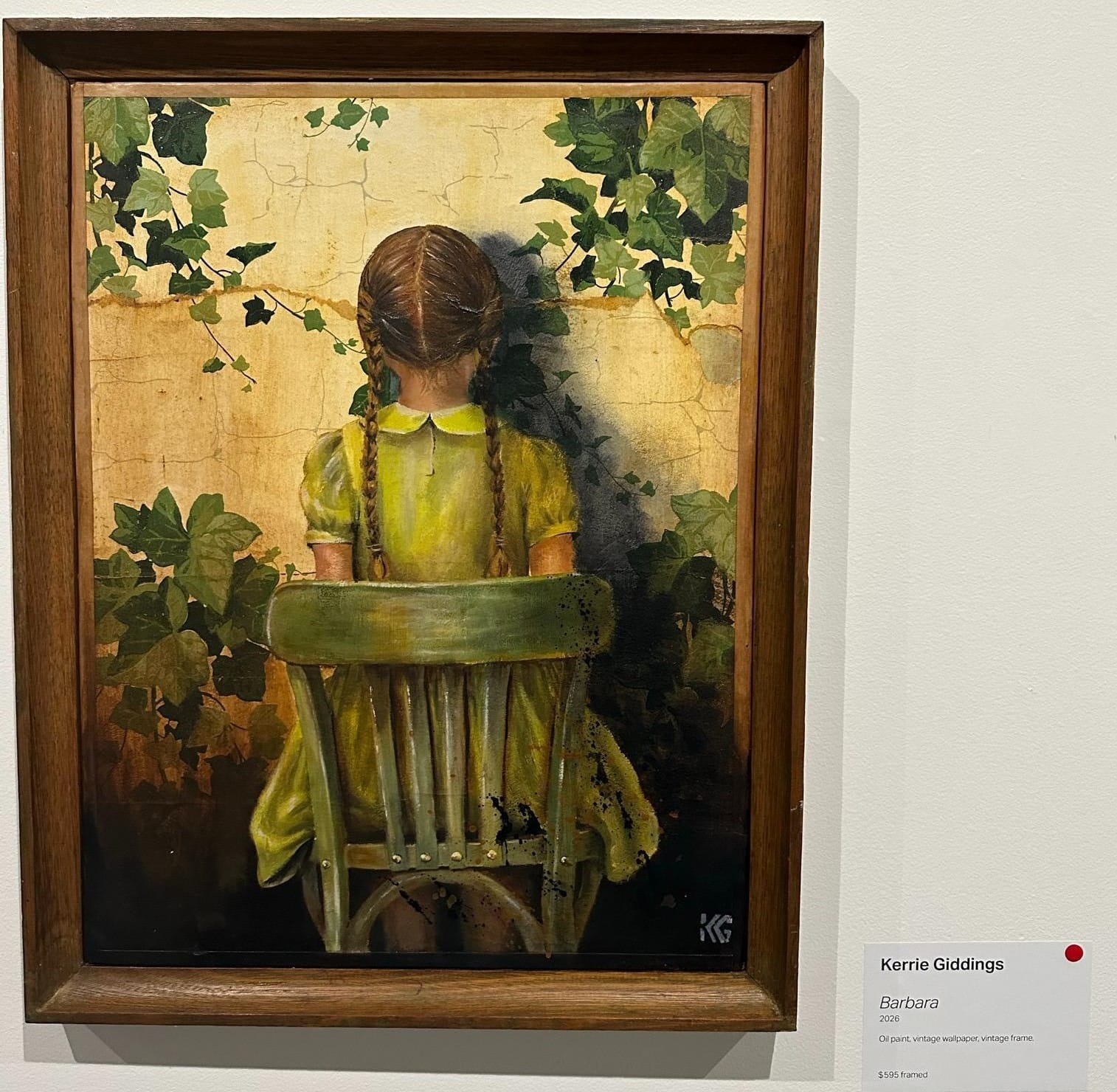
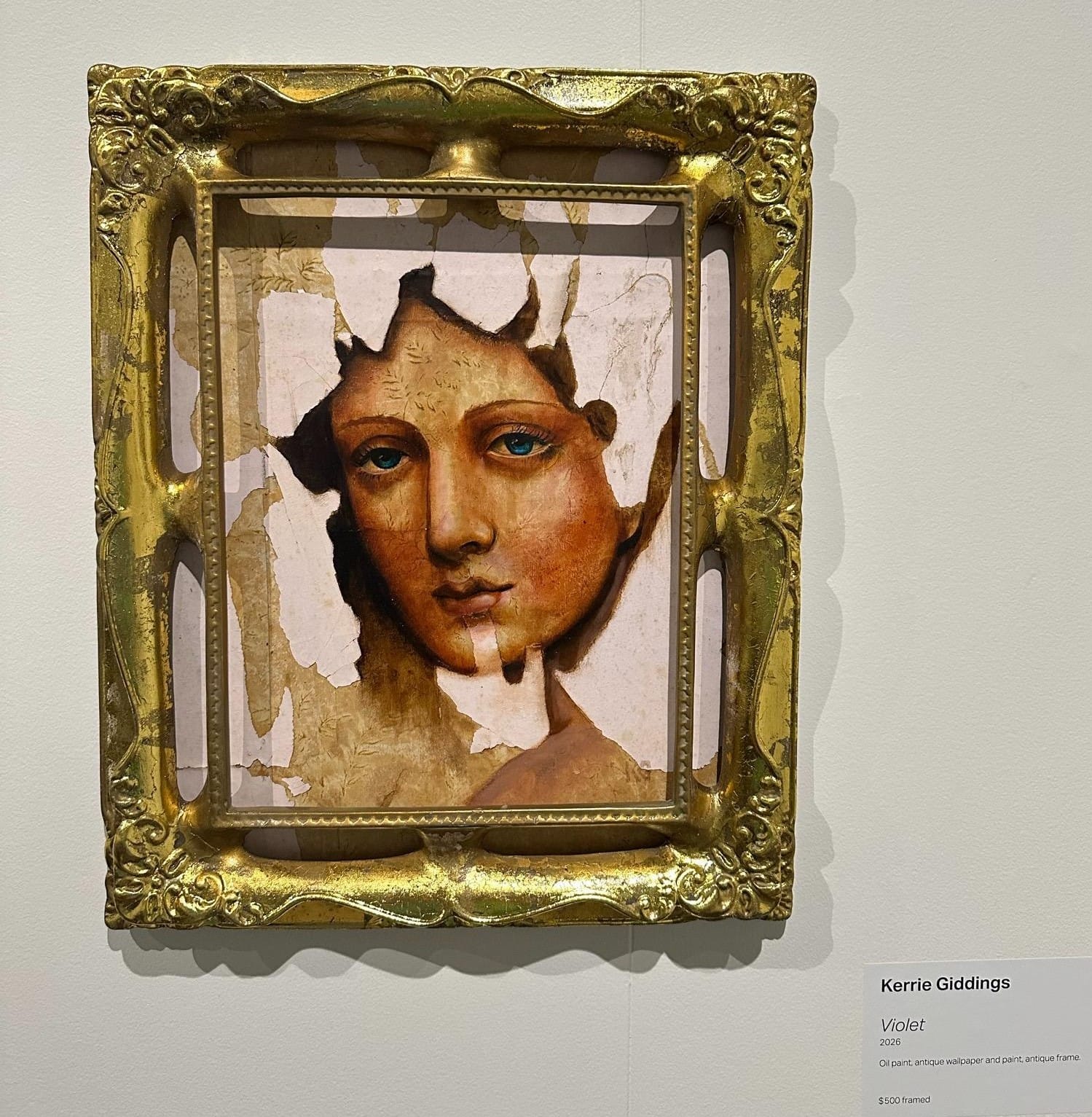
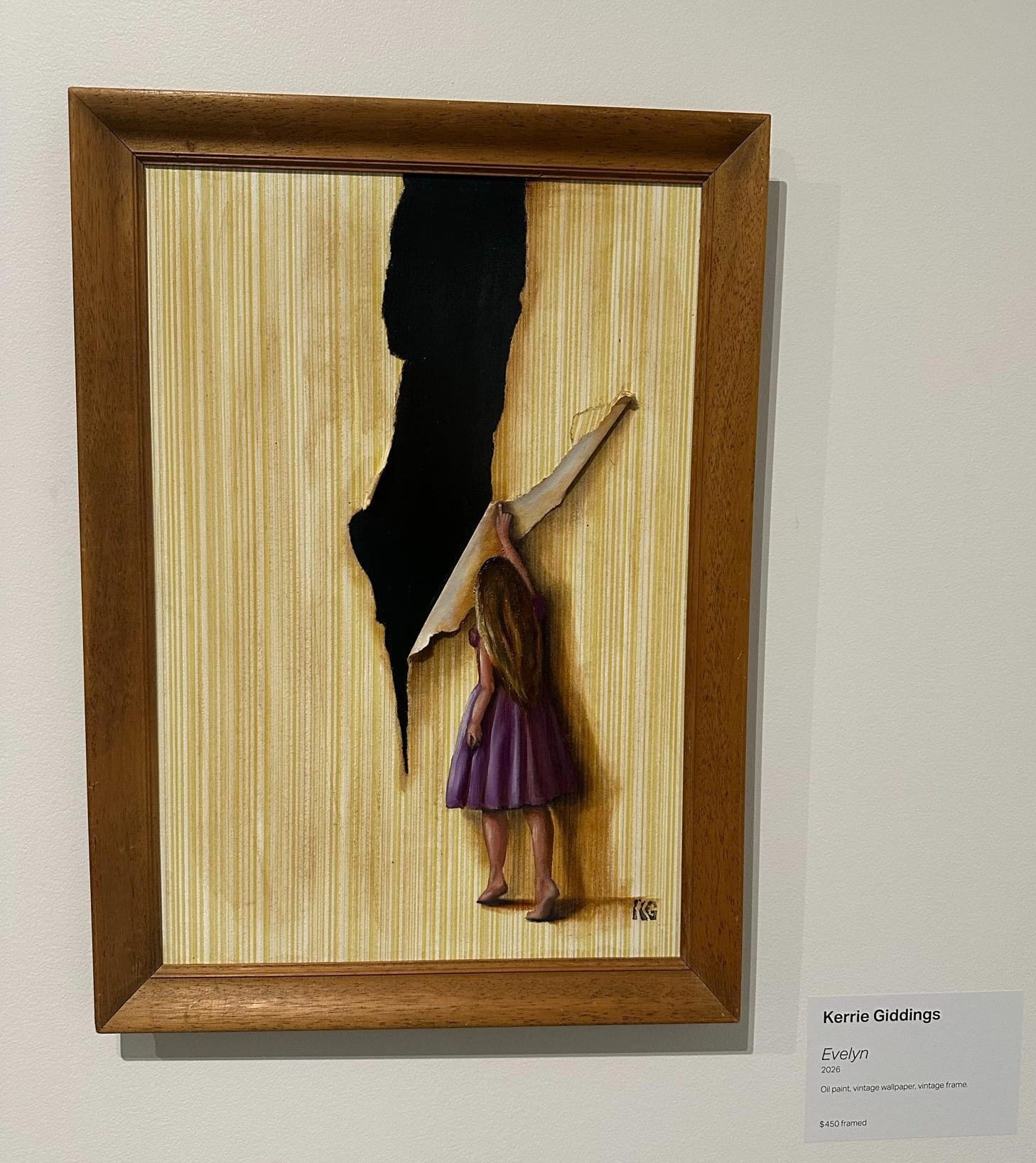
An interest in textiles connects both exhibitions, expressed here through the construction of clothing using wallpaper and oils. Also, like Munn, Giddings’s work has an affinity with a type of historical femininity, one which she views as domestically bound and specific to the home. In many of these paintings the women look unhappy, as though they would like to leave. Some young women face the patterned walls and we don’t see their faces. Meanwhile, in other paintings, young girls actively try to escape the frame through gaps in the wallpaper setting, either looking or climbing towards a landscape outside.
Domestic interiors are only hinted at, however, as the mode of portraiture has women looking composedly at the viewer. Their boundedness seems to come only from the wallpaper as a patterning device, sometimes very effectively used as a trompe l’oeil. Giddings has a deft touch with oils and skillfully blends the two media, while creating realistic, quite big-eyed, big haired, women.
Yet the use of wallpaper—as both the dress fabric and background interiors—for these women’s worlds is compelling. Again, I’m reminded of the demands that femininity be performed in ways that fit social expectation, particularly in the eras the artist has chosen.
The artifice and performance—in this stereotypical view—are what define the feminine.
And yet, the 1950s to ‘70s saw some of the most radical changes in the lives of women in Australia.
The women and girls do not look happy and this fact clues me in to Giddings' exploration of quiet resistance. She isn't concerned with what was happening socially or politically for women. Instead it's the construction of femininity using specific ingredients that I think the artist is concerned with. While they’re all tanned and Anglo-looking in appearance, there are only one or two the age of a grandmother; giving the impression of magazine advertising. Are they portraits in the sense that they are real women who sat for the artist, or are they composites inspired by advertising's fantasies of femininity? Either way, they look to the viewer with reserved expressions, not overwhelmingly happy to be there.
The introduction to the exhibition concludes with:
“Rather than presenting a fixed history, the exhibition invites reflection on the lingering echoes of repression, while honouring women’s complexity, beauty, and strength through acts of visibility, reclamation, and quiet resistance.”
This is an ambitious goal for the exhibition, and had me wondering about the way it was being framed in the text. There are clear narratives playing out for the women and girls depicted, their lives constructed by surface patterns and textures, their appearance dictated by processes outside their control and - in the case of the young girls - their active attempts to escape these confines. All of this comes across from the artworks (rather than the exhibition description) and compels me to speculate on the artist's intentions.
Back at Workspace 3496 +Gallery, Munn’s dress now hangs in the exhibition space adjacent to other textile and video works which complete the exhibition. Moisterise is part of a series she began in 2000, alongside Cleanse and Tone which I watch on a low TV nearby. The physical presence of the female body in the gallery space is once again the artist’s primary concern, while also rendering familiar self-care rituals strange. Routines become rituals and something intimate and domestic is exposed as artifice.
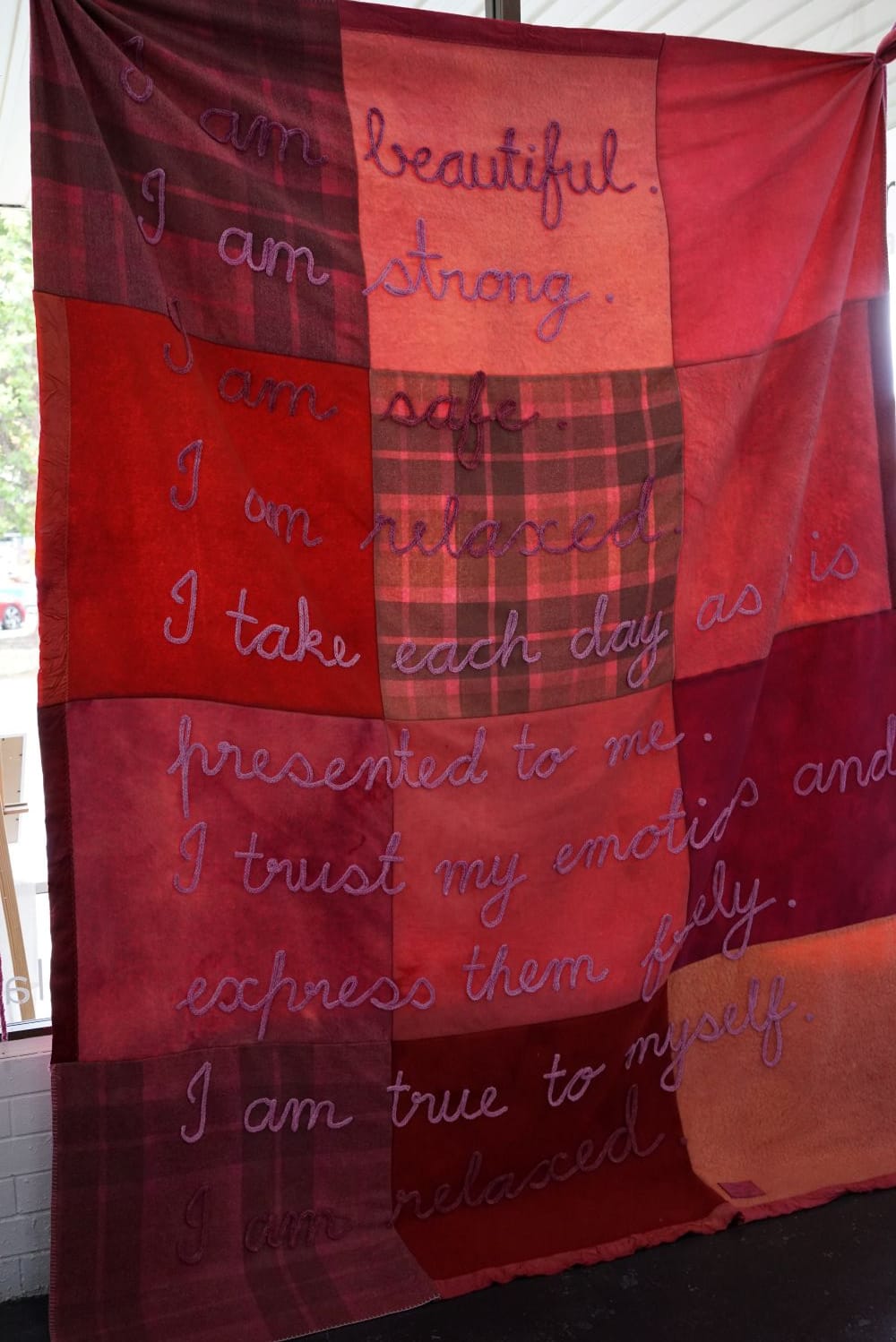
The emphasis on handmade textiles in the rest of the exhibition is a deliberate nod to Munn’s interest in craft and so-called women’s work. She’s had an interdisciplinary textile practice for over 30 years, and some of her process is included in the exhibition. A large wall hanging features “I am” statements and serves to block the outside light partly from the gallery. These are positive phrases reminding all of us of the need for self-compassion and once again tapping into a rawness that is at once most often feminine and but verges on oversharing (by unreasonable social standards). The repression of emotion by men is equally strong in patriarchal societies where weeping is weak. That we cringe at expressing strong emotions, that we’re told to process these things privately is the actual indictment.
It’s these dimensions, and the double standards and hypocrisies that abound in the lives of women, that I felt were only hinted at in Giddings’ work. It would have been fascinating to see these themes more fully explored through the medium of oil, wallpaper and vintage frames.
Janelle Monae's Pynk sums up many of the vibes that both of these exhibitions inspired me to think about, taking the theme of performance art and gendered performance to all round interesting places.
The Weeping Place was on display from 1 to 21 November 2026 at Workspace 3496 +Gallery.
Her Patterns was on display from 18 September to 22 November 2026 at Mildura Arts Centre.
Post script
Last year I wrote about the art scene in Broken Hill, and in particular the fantastic work being shown at Slag Heap Projects. After three years the gallery have been told they're being evicted from the space they've poured blood, sweat and grant funding into, not to mention uncountable volunteer hours. As the ABC reports, Slag Heap are not the only organisation threatened with an uncertain future, Broken Hill Art Exchange's lease is also tenuous after the building has been put on the market.
The precariousness of spaces and opportunities for artists is not just a regional issue, but for a city whose identity has long been tied to supporting every stripe and colour of creative endeavour this is a big blow. This is incredibly disheartening in a censorious environment of restricted resources which are challenges felt more acutely in regional centres.
Which brings me to this statement about the arts more broadly in Australia: Who owns the arts in Australia - open letter. Required reading, particularly if you are the prime minister or federal arts minister and you're considering reducing the copyright protections for creators in Australia.
Just noting that, at a time when Australian democracy is more threatened than ever, the importance of art education, noted by the open letter above, should be accessible for everyone:
Education in creative arts and the humanities is a public good, rather than a private gain to be recovered from graduates. Increases to the cost of creative arts degrees have led to significant decreases in enrolment, with dire consequences for the next generation of creative talent in Australia
This appears to be censorship by another name.
Lastly, a shout out to Susie Anderson's excellent review of The Uncomfortable Truth with Maree Clarke and megan evans at Boroondara Town Hall Gallery. I wanted to end on this note because of the excellent questions that Anderson asks in this review. If you've made it this far, give it a read too.