The Australian inland as something other than harsh and alien
I go down a rabbit hole with Russell Drysdale before reviewing two Mildura exhibitions.
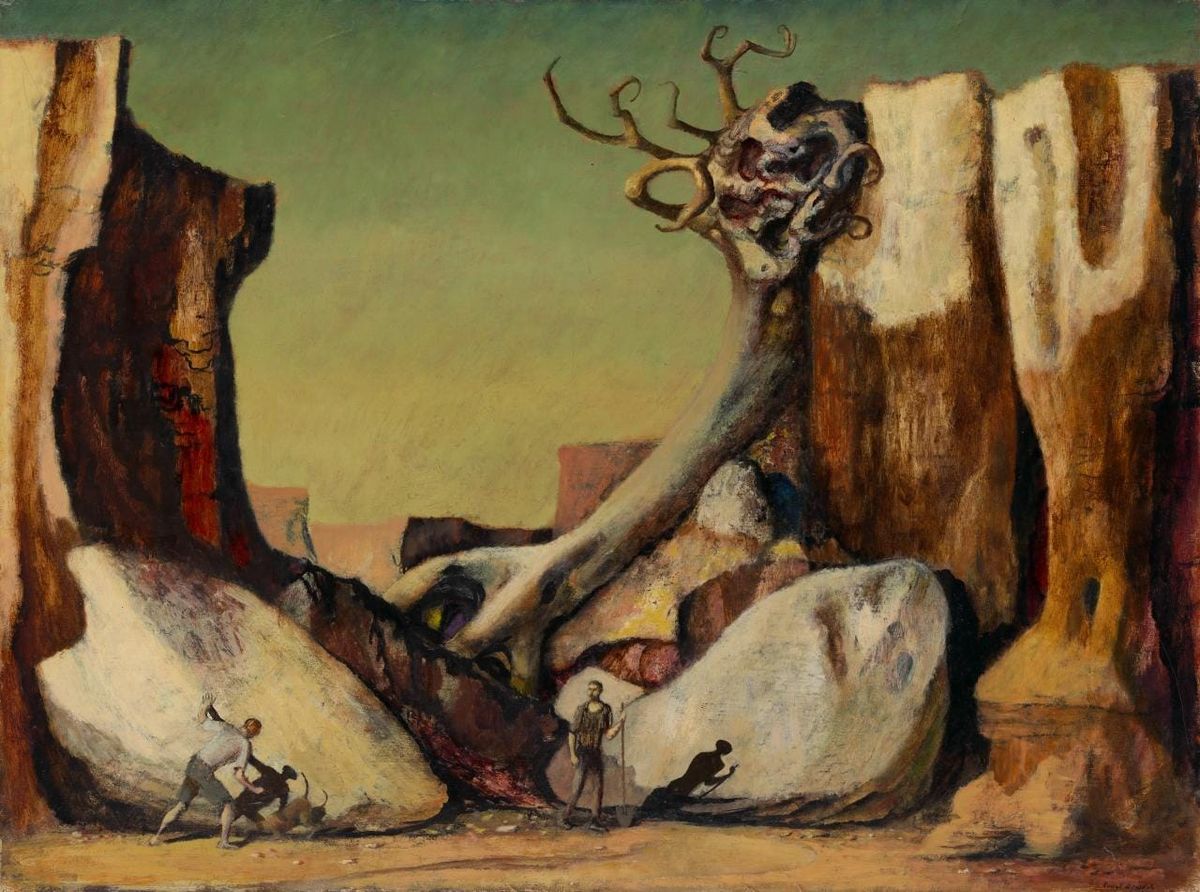
It’s the unsettling yellow colour of the sky at the horizon which reminds me of a dust storm, and the looming rocks, in Russell Drysdale’s painting The Rabbiters from 1947 that signals the outback to me. Giant orange cliff faces tower over skinny figures as they hunt for rabbits in a landscape devoid of green. The only wood to be seen is a gnarled and, frankly terrifying, fist of a dead tree trunk. It towers over a man and his shadow as he walks towards the viewer. His companion looks away from us as his dog smells a rabbit under one great, faded rock.
The drama of this painting for James Gleeson, a contemporary of Drysdale’s writing in Australian Painters (1976), is found in the landscape itself, not the inconsequential activities of the rabbiters. He sees the men as transformed by the landscape, not so much the other way around. To me though, this reversal of the usual order of colonial domination still manages to highlight how foreign whitey is in such a space. The men have become like the dry environment they’ve chosen to occupy, and they are forced to reconcile a little with the pest they’ve introduced in order to feed their skinny frames.
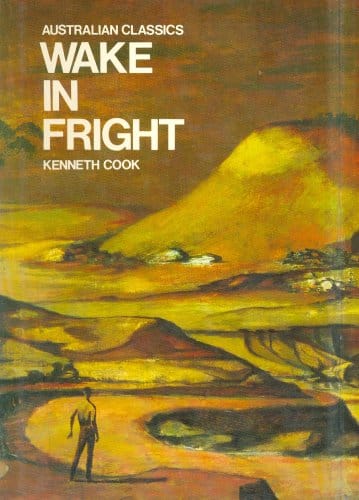
For Gleeson, a surrealist painter as well as writer, the men have become part of the landscape through an acceptance that leads to “a kind of grave serenity”.1 Drysdale’s depiction of rural and regional Australia has become part of our national consciousness and, according to Gleeson, we cannot visualize certain aspects of landscape or way of life without reference to his imagery. Case in point, Drysdale’s Road with Rocks (1949) is featured on the hardcover edition of Wake in Fright (Angus and Robertson).
For Bernard Smith, writing a little earlier than Gleeson in 1962, these qualities make Drysdale one of the most original landscape painters Australia has produced. Smith sums up Drysdale’s landscape as “alien to man, harsh, weird, spacious and vacant, given over to the oddities and whimsies of nature, fit only for heroes and clowns, saints, exiles and primitive men.”2
This version of the Australian bush interested Drysdale in ways that make another iconic painter of Australian landscape, Authur Streeton, look like the tourist he was. The summers are not golden in Drysdale’s paintings and there are no comfortable stockmen doing heroic deeds on horseback. A dust storm is always imminent.
Though born in Sussex, England in 1912, Drysdale’s family was associated with Australian colonisation since the 1820s. As pastoralists, first in Tasmania and then the Western District of Victoria, the Riverina and northern Queensland he fully expected to follow family tradition, and it was only by accident that painting became his occupation. Smith contends that while ill in Melbourne in 1932 Drysdale met Sir Daryl Lindsay who advised him to study under George Bell.3
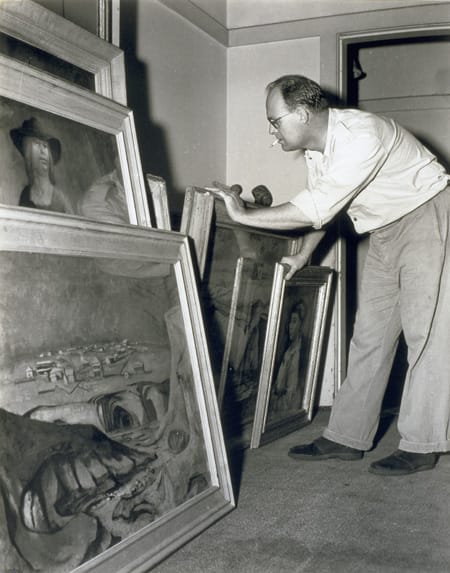
I’m not contending that we can read any level of colonial guilt in Drysdale’s paintings, or that they are in any way post-colonial. He was probably exceedingly comfortable using his family connections to establish himself in Albury or visit the Riverina during drought, and in the process gaining inspiration for paintings. His depiction of far Western New South Wales, where I now reside, rings true on a thematic, metaphoric level.
I admire the exploration of how settlers have connected to the hot, dry spaces, but I also know they are not the only features out here. Smith’s use of the word vacant above, irks me but he is correct to highlight the oldest convention about Australia’s landscape as “monotonous, unpicturesque, idiosyncratic, alien and hostile to man, inducing either loneliness and melancholy or nonchalant resistance.”4 This is was a useful image to have of the inland, it allowed for nuclear testing among other things. Drysdale usefully responds to this convention but shows an inland that is more psychological than anything that has come before. Both Gleeson and Smith attribute this to the surrealist elements in his work and the way he uses colour and figuration as well as deep perspective to create a disquieting and absurd effect.5
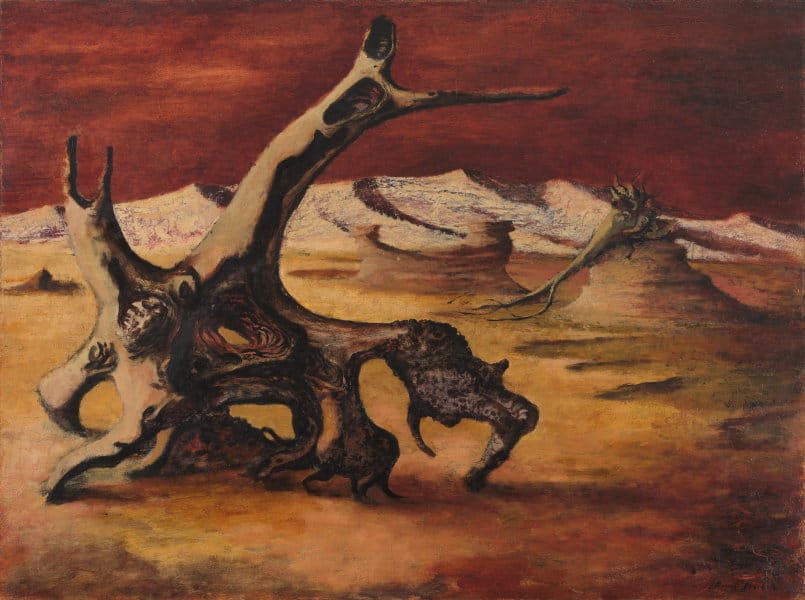
He painted the landscape at Lake Mungo in 1945, inspired by a trip to the far west of NSW to document the drought for Sydney Morning Herald in 1944. Australia’s oldest human remains were found at the site a few decades later, but there is no reference to the oldest, continuous living culture in this painting. The Walls of China, as the specific lunette landform is called, makes up a creamy white slice of middle ground, in front of a blood red sky. The foreground is taken up with another expressive and sinister tree stump. It was the softest, finest clay that preserved Mungo Man and Mungo Lady for 40,000 to 42,000 years. The landscape they knew was verdant and rich enough to sustain a significant population through a diversity of plants and animals which have since retreated to the edge of the river systems of the Barka/Darling and Murray.
Drysdale did examine Aboriginal subjects in portraits, but like many before him, he went north to find them – once again following the conventions that true Aboriginal Australia was only observable in the north of the continent. That was in 1951 and Smith suggests Drysdale did not emerge unscathed from his trip to Cape York, describing it as “dangerous iconographic territory”.6 Drysdale adopted a highly realistic treatment of these subjects but also used elements of Aboriginal art in his portraits of men and women, with backgrounds reduced to flat decorative surfaces, off-focus figuration and continued the surrealist, romantic, hallucinatory elements from his other paintings.
Shopping Day (1953) does depict an Aboriginal family in an inland town but Drysdale has made their faces inscrutable and instead given, what seems to me, a far more sympathetic treatment to the empty background townscape. Two women and two children look at the viewer, there are no other figures beside a statue of a trumpeting soldier on a plinth. The dusty road and sky tinged with dust-storm yellow only add to the feeling of isolation in this picture.
My thoughts were occupied by many of the peculiarities about living in the inland while I prepared to review Mildura Arts Centre's latest landmark exhibition. MAC celebrates 70 years this year and a special selection from its collection has been chosen to represent seven decades: 2D or not 2D. Like MUMA’s 50-year publication I mentioned in my last posting, MAC has reflected on its history and how to commemorate a complex and not uncontroversial past.
Mildura is the furthest you can travel north and west without leaving Victoria (with the exception of Merbein), its boundary formed by the Murray river on the northern side. If it wasn't for this life-giving force, surreal images not dissimilar from those drought-stricken landscapes that Drysdale created could have been the norm (Broken Hill was once surrounded by trees, let's not forget). Instead it was made an oasis - for art and agriculture.
The origins of the arts centre were deliberately radical and in reference to the significant distance from Melbourne. As Marg and Stephen Naylor show in their catalogue essay, “isolation offered space to experiment, absorb new ideas and quietly reshape the cultural direction of a regional centre on the edge of change.” This utopian vision, advocated for from the metropole by National Gallery of Victoria director Eric Westbrook, did not always gel with the locals and many of the controversies that pepper the last seven decades are useful examples of how to navigate differing positions on art and its place in public life. I’ve written a little about this previously.
Founded as an irrigation settlement by wealthy Canadian plumbing enthusiasts George and William “W.B.” Chaffey, Mildura was heavily focused on taming an increasingly dusty landscape. Mildura’s new art centre may have opened at a transitional time for Australian art but the 1950s were still so conservative that it seems astounding that the town achieved the level of support and innovation in its arts and culture that it did. My opening exploration of Drysdale’s work is intended to contrast with this, very different, experience of the inland.
A bequest from R.D. Elliot, senator and director of the Sunraysia Daily newspaper, established the foundation of the collection. His wife offered to pay the salary of a gallery director for two years in order to get the gallery off the ground. Rio Vista, the mansion built by W.B. Chaffey, was purchased for the purpose by the Mildura council in 1950 and opened in 1956 to display not only the Elliot’s collection but the entirety of the Chaffey’s furniture.
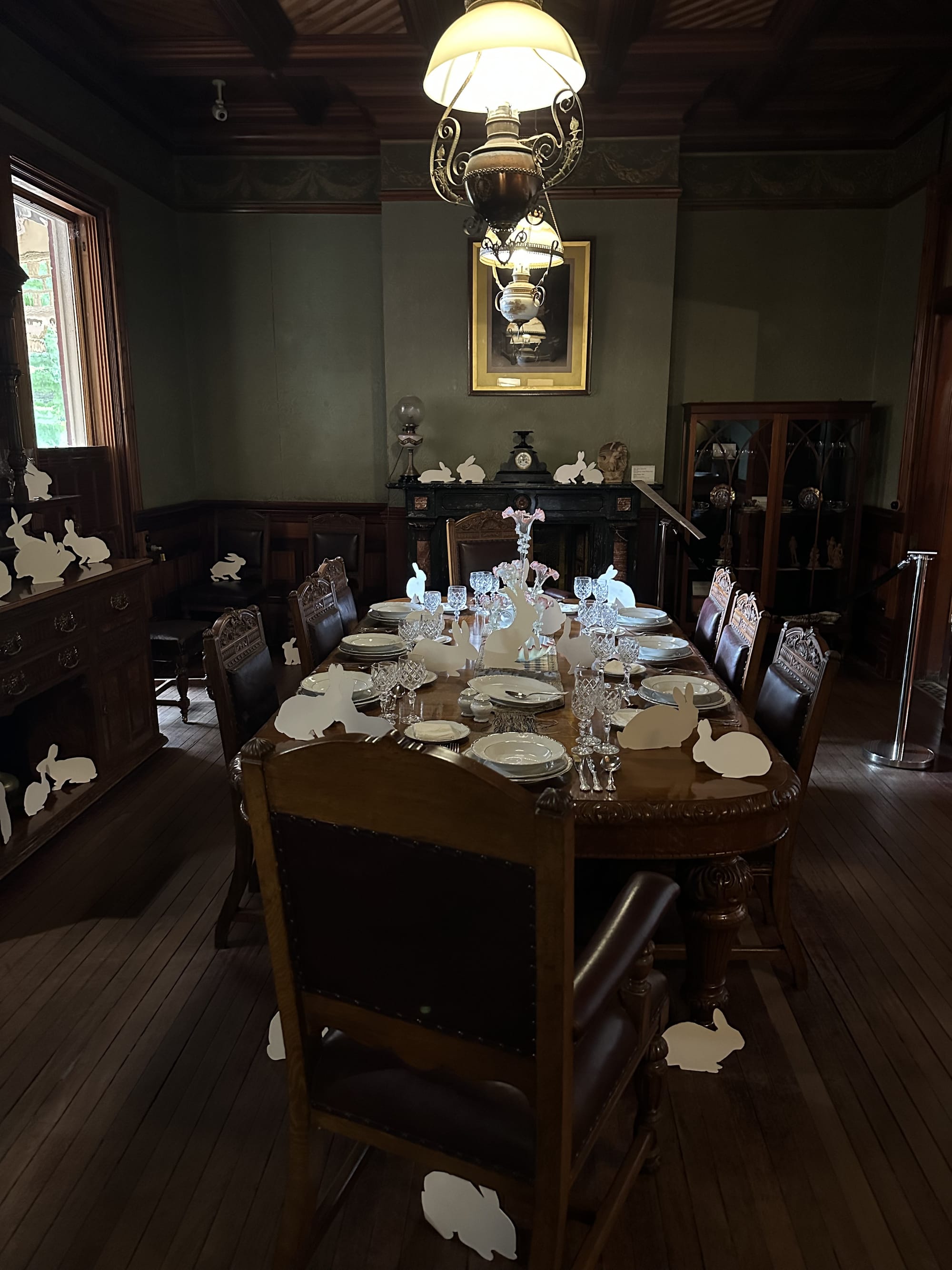
For 2D or not 2D Mildura artist Danielle Hobbs’s installation from 2009 is installed in the wood paneled and elaborately staged dining room of Rio Vista house. These white silhouettes are terrible guests and have made themselves at home on surfaces where no rabbit should go. The artwork is titled Emotional Landscape (The Dinner Party) and references her complex emotions about motherhood (via Judy Chicago). I can’t help but draw connections between the impact of rabbits on the landscape and human terraforming which was essential to Mildura’s success as a settlement.
In the 1890s economic crisis in Victoria, when the Chaffey brothers were struggling to realise the irrigation colony of their dreams, those who doubted them suggested they get out “for it was obvious that Mildura would revert to the rabbits and crows”. So wrote Alice Lapthorne in Mildura Calling (1965). The image of rabbits claiming a dusty inland settlement, watched over by crows, sounds like a Drysdale painting. Equally, rabbits taking up space at a dinner party makes the point that the climate interventions made by humans often go awry and we are now forced to contend with the rude consequences.
Unexpectedly it was sculpture that Mildura became internationally known for in the 1960s and 70s. Under the direction of Eric Westbrook and subsequently Tom McCulloch, an outward-facing approach was adopted: collecting contemporary artworks and presenting audiences with national and international trends. In part the contribution of MAC directors, the support of councillors, community advocates and local teachers was also essential to develop this unique focus. Pushback arrived in the 70s, during the tenure of director Tom McCullough when artworks were less formal and more challenging to local audiences, culminating in the burning of the 1978 Mildura Sculpture Triennial catalogue and McCullough’s departure.
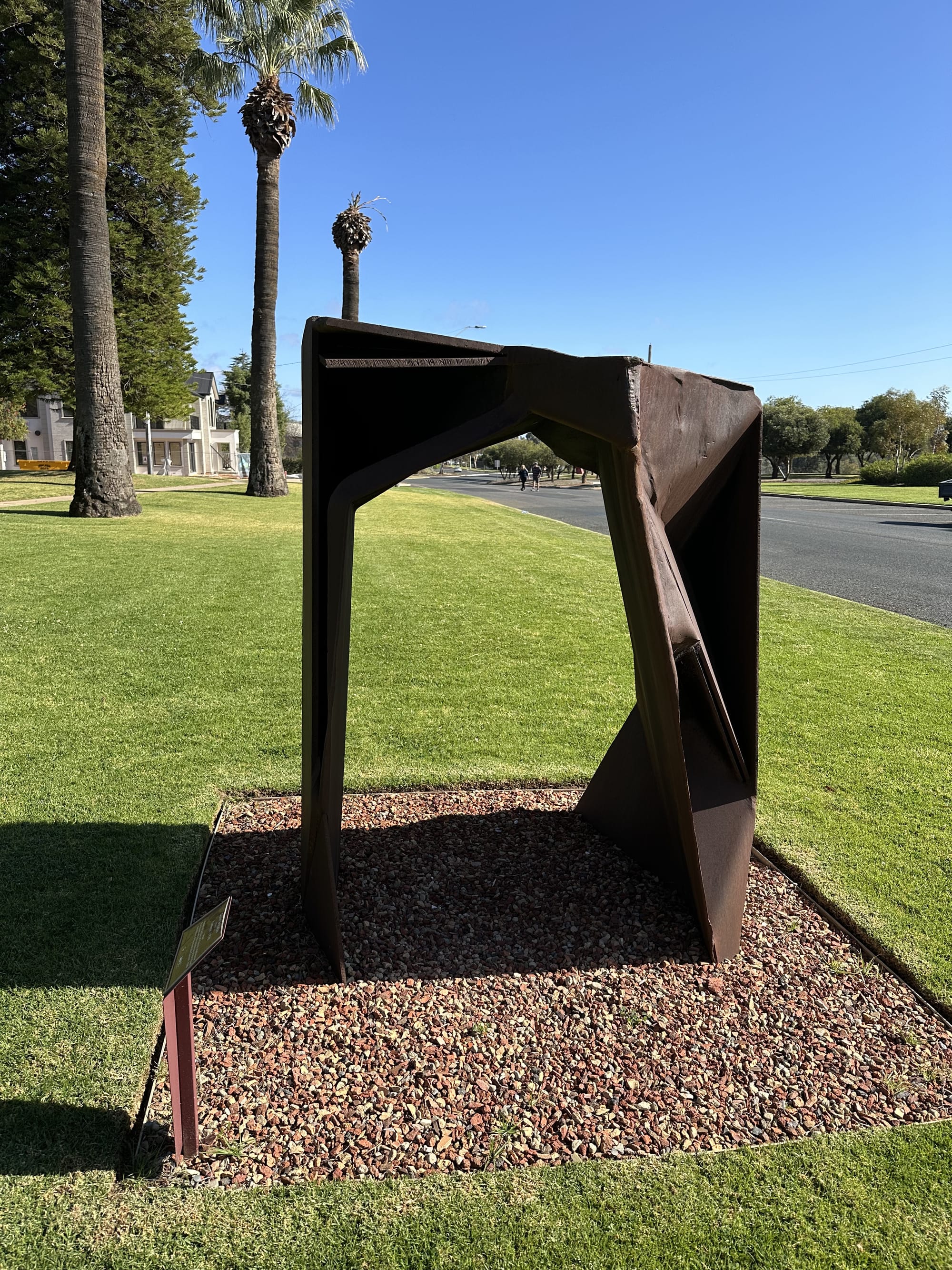
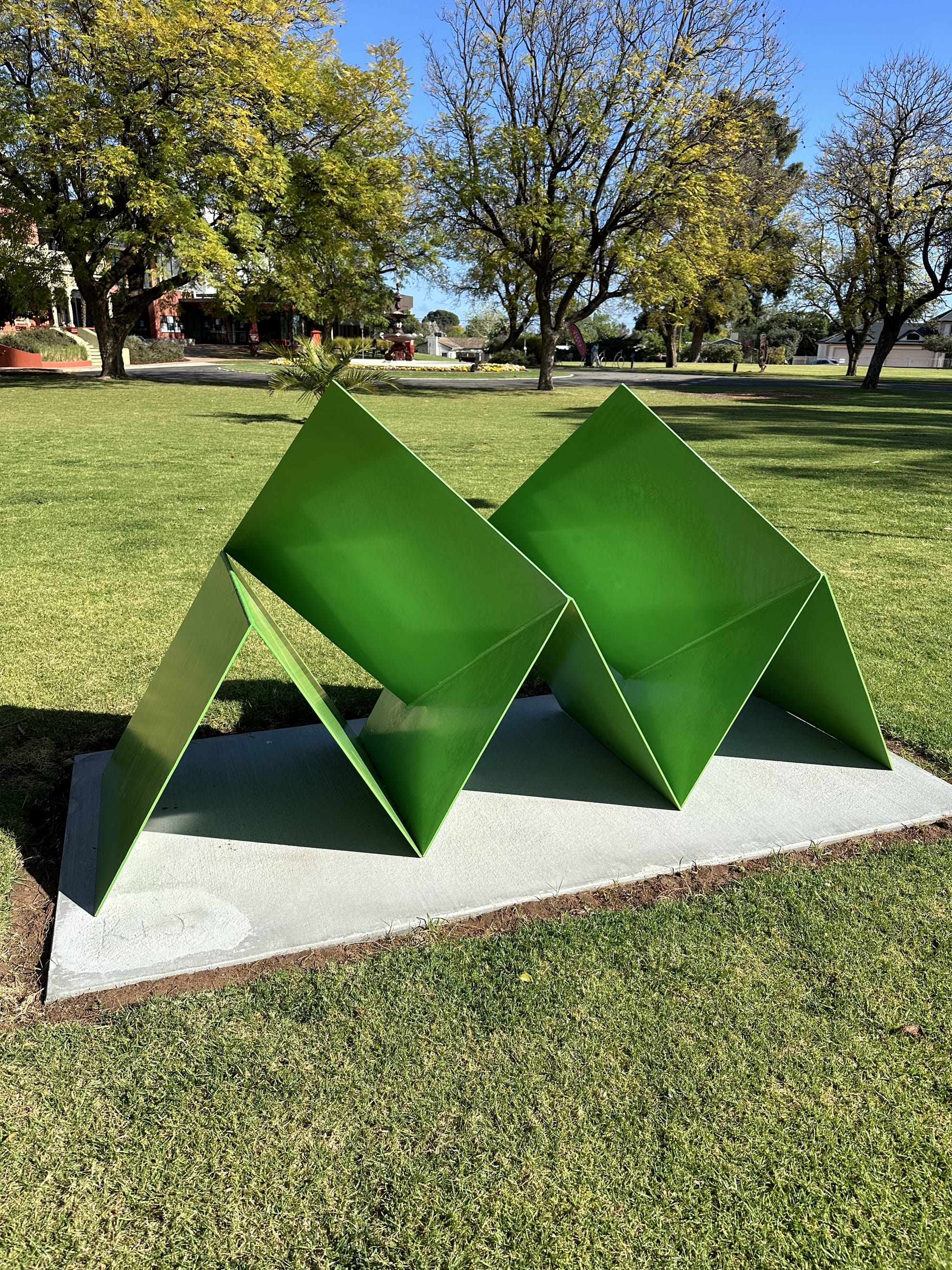
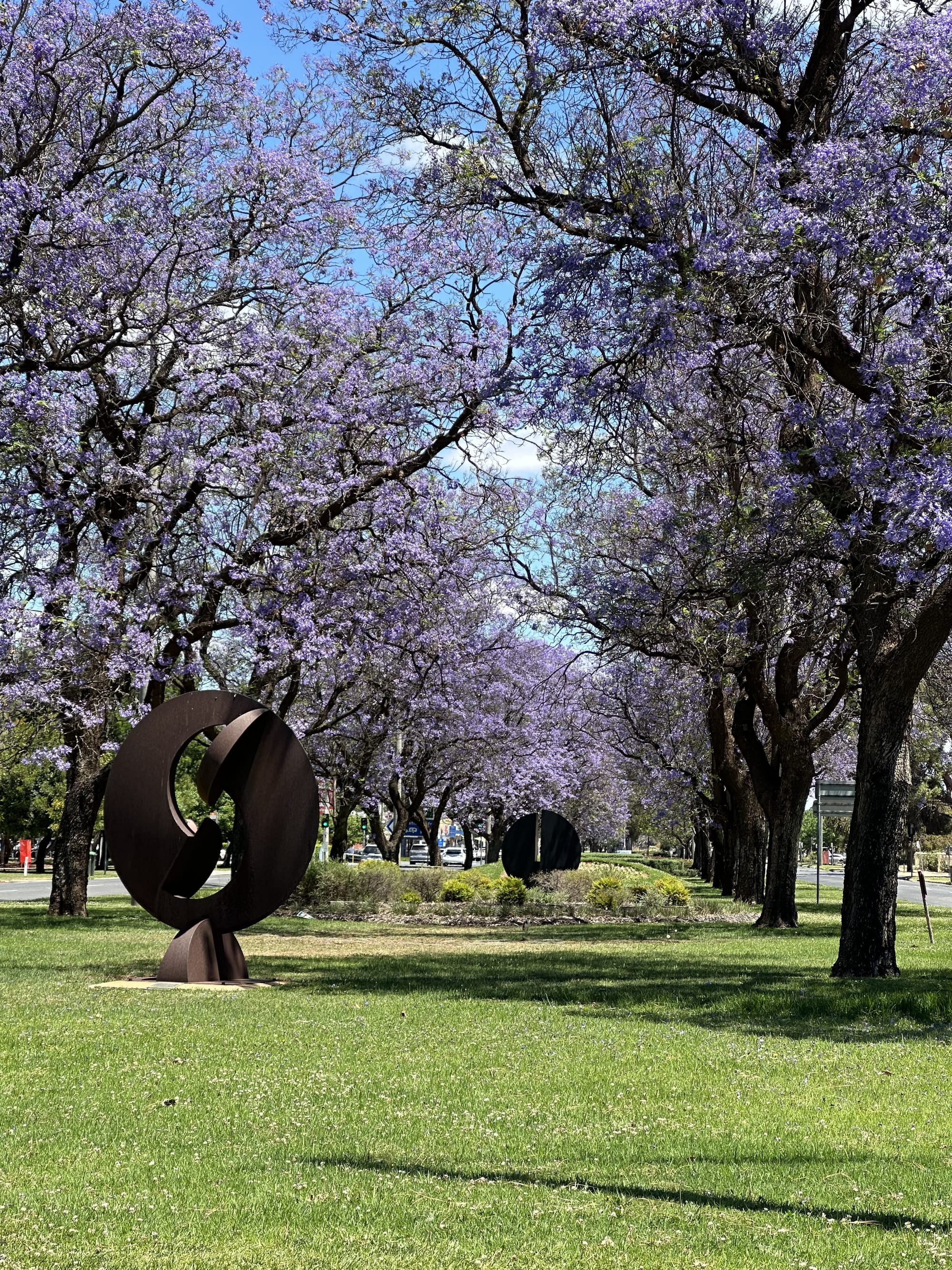
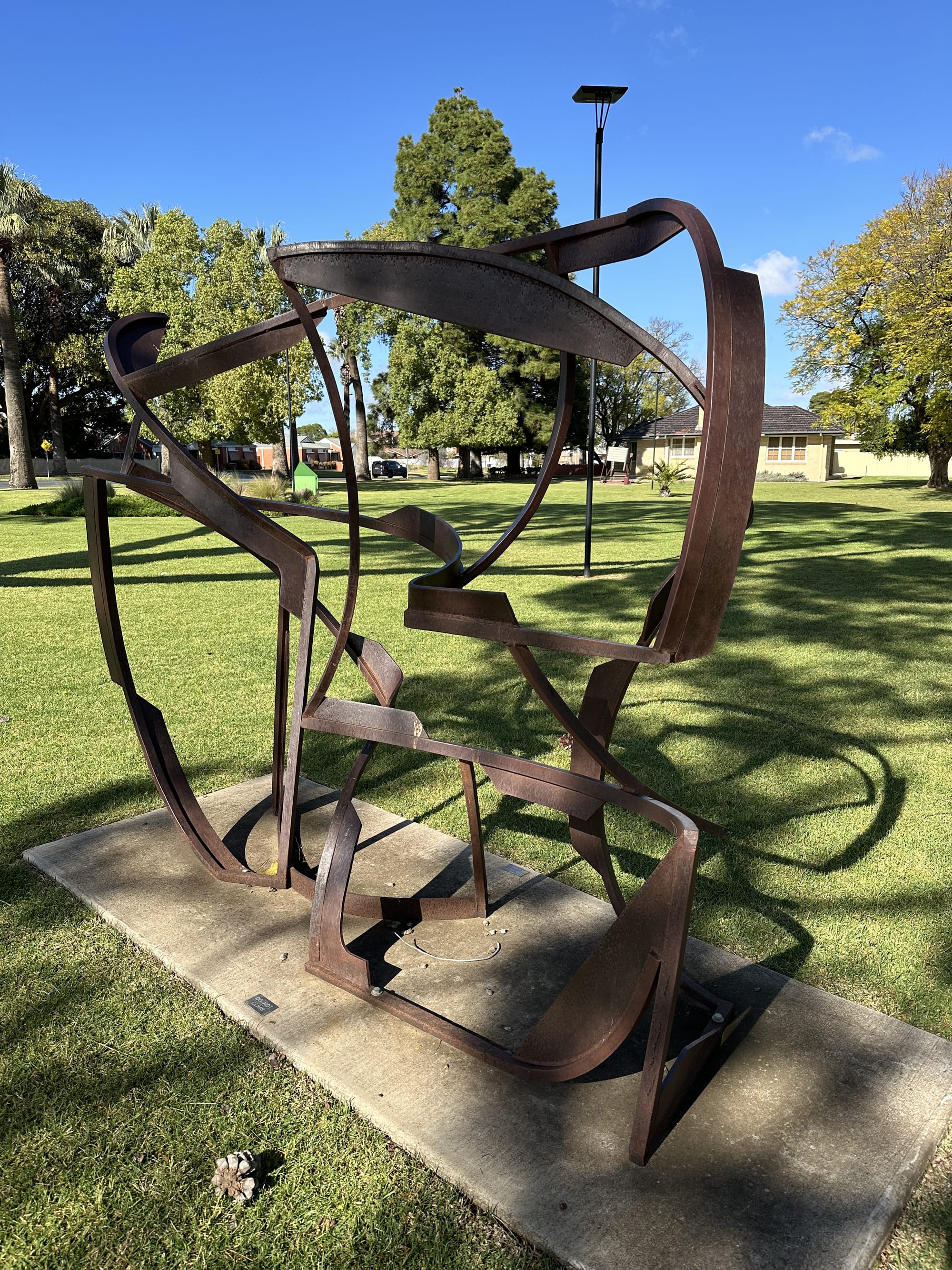
Clockwise from top left: David Wilson Passage 1978; Ron Robertson-Swan Beethoven 1963 (recreated 1968); Owen Broughton Steel Construction 1978 & Inge King Black Sun 1975; Paul Hopmeier Uncle Toby 1982 (author's photos).
The artworks chosen from this era in the 2D or not 2D exhibition demonstrate the ambitions of the period and the experimentation which fomented the important engagement between regional and metropolitan artists from around Australia. The artworks are small but contrast strongly with a selection of local artists on the opposite wall. The space is divided by John Davis’s long, beguiling Unrolled Piece (1973) which consists of ceramic rods sewn into a kind of very long artist’s travel bag, as though they were brushes or tubes of paint.
As the history of sculpture in Mildura shows, the place itself was essential to this gathering of ideas and artists’ practices. The legacy is evident in MAC’s grounds as well where examples of these sculptures survive. Some need restoration, as noted by Erica Tarquinio in her appraisal of Mildura’s artistic position in Artlink (2024), while others find a place in tourism campaigns to draw attention to the city’s arts scene.
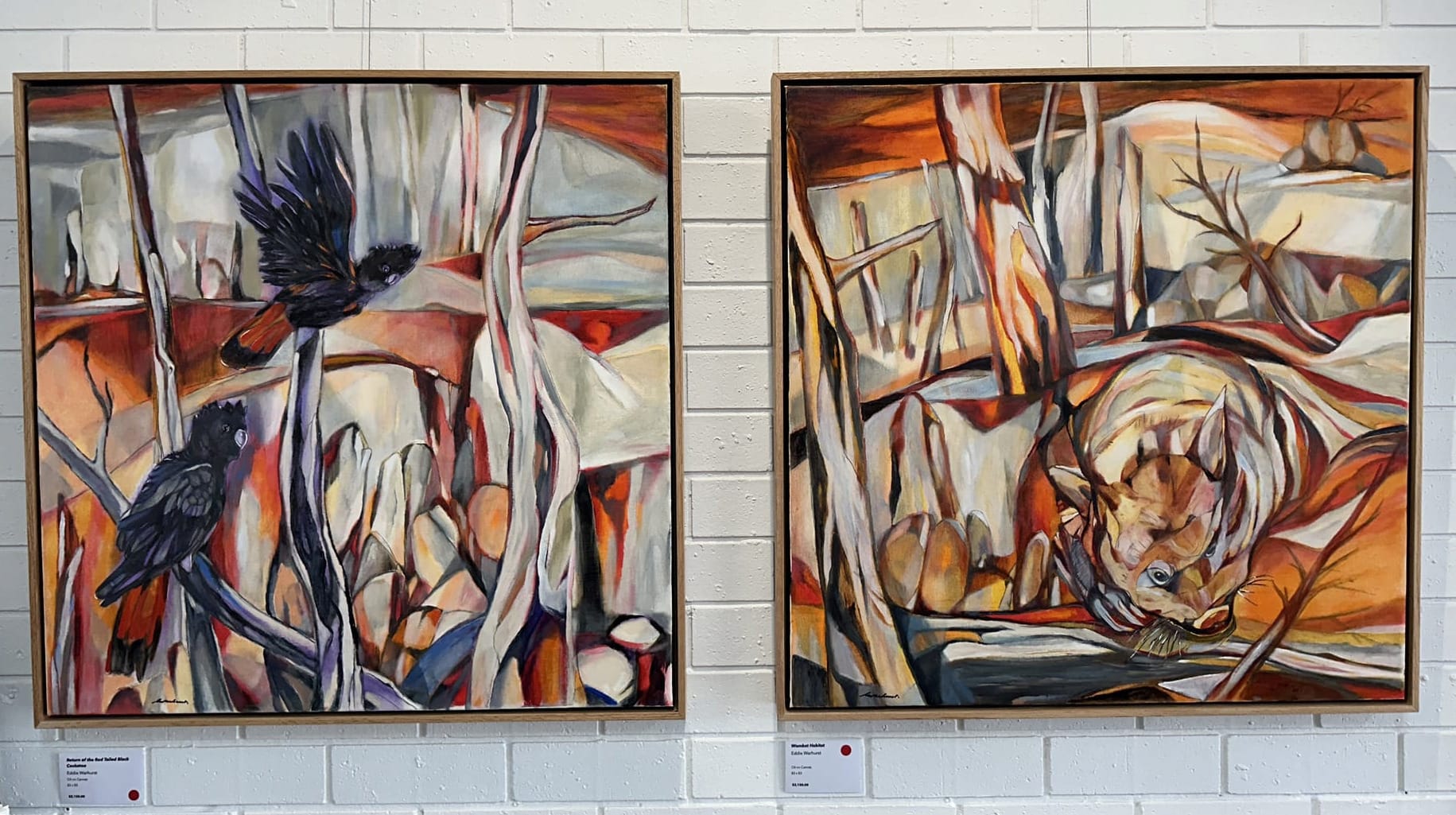
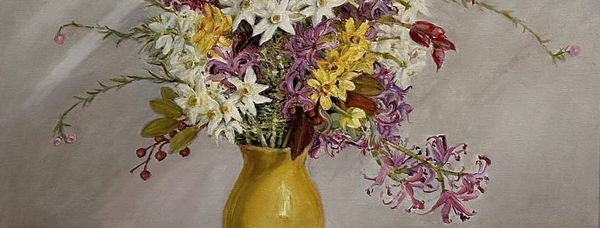
Another exhibition also prompted the Drysdale rabbit hole I’ve been down today: Eddie Warhurst’s Sandhills to Seascapes (closing today at Workspace 3496 +Gallery). There is a Drysdale-esque quality to Warhurst’s paintings that struck me when I visited. The picture plane is tipped and abstracted and the colours of the mallee landscape are just as barren as many of Drysdale’s. Warhurst, though, is also interested in the coastal landscape at Aireys Inlet, southwest of Melbourne, so the exhibition produces a dialogue between the inland and the coast, between dusty oranges and windswept blues.
Eddie Warhurst is a well-known figure in Sunraysia, an ex-mayor and local organiser, his name is synonymous with supporting surrounding small towns. Trained as a secondary art teacher, his career as a painter has taken him from the hot, mallee landscape, to the equally windswept Aireys Inlet, where he now resides. Rather than the connection between humans and the landscape, his work emphasises animals, and this is a big departure from the iconography of painters like Drysdale where the landscape becomes an all-consuming character.
Magpies are especially prominent but emus and wombats in distilled and abstract forms move across the compositions with a strong sense of reclaiming space. This feeling of humans as secondary is further enhanced in Warhurst’s most recent paintings which are more abstract and tilt the geography in such a way that depth and perspective are slightly unsettled.
I enjoyed Warhurst’s exploration of tree forms as well, which have none of the sinister energy of Drysdale but remain unmistakably from the inland. A different passion for place comes from these paintings reflecting a connection to two locations that the artist has connected with over many years.
Sandhills to Seascapes was presented at Workspace 3496 +Gallery in collaboration with Mildura Arts Centre as part of the 70th anniversary celebrations, from 4 to 24 October 2026. 2D or not 2D is on display until 29 November 2026 at MAC. Russell Drysdale’s The Rabbiters is on display in Gallery 8, NGV Australia in Melbourne and in Sydney Crucifixion (1946) and Sofala (1947) are on display in the Art Gallery NSW’s 20th Century galleries.
As always, let me know what you think. Have you visited a Drysdale recently or seen a particularly inspiring example of landscape surrealism?
Works cited:
1 James Gleeson, Australian Painters: Colonial 1788-1880, Impressionists 1881-1930, Modern 1931-1970 (1976), 347.
2 Bernard Smith, Australian Painting, (1962), 251.
3 Australian Painting, 242.
4 Australian Painting, 245.
5 Australian Painting, 244.
6 Australian painting, 251.