To see the world in a grain of sand and heaven in a wild flower
I review three exhibitions at Mildura Arts Centre, each concerned in their own way with the importance and beauty of nature.

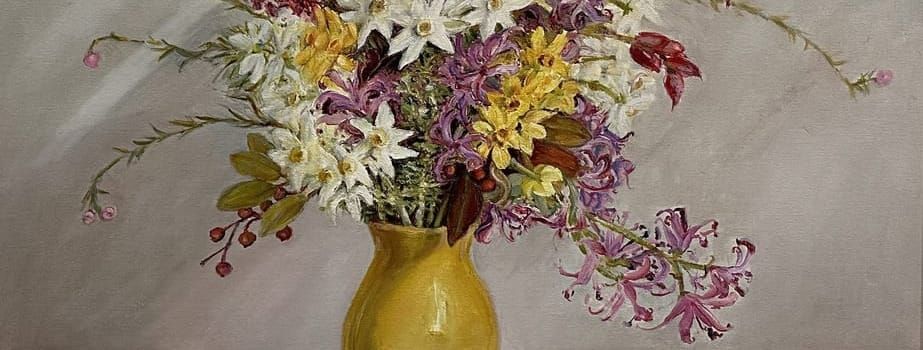
Three women painting still lifes of flowers might seem like a staid premise for an exhibition of emotional intensity, but Little Gardens of Eden proves anything but formulaic.
To be inspired by nature and observe it with oils or acrylics (or a combination of the two) is to connect with the more-than-human world and appreciate the worlds within flora, if we permit ourselves to look slowly.
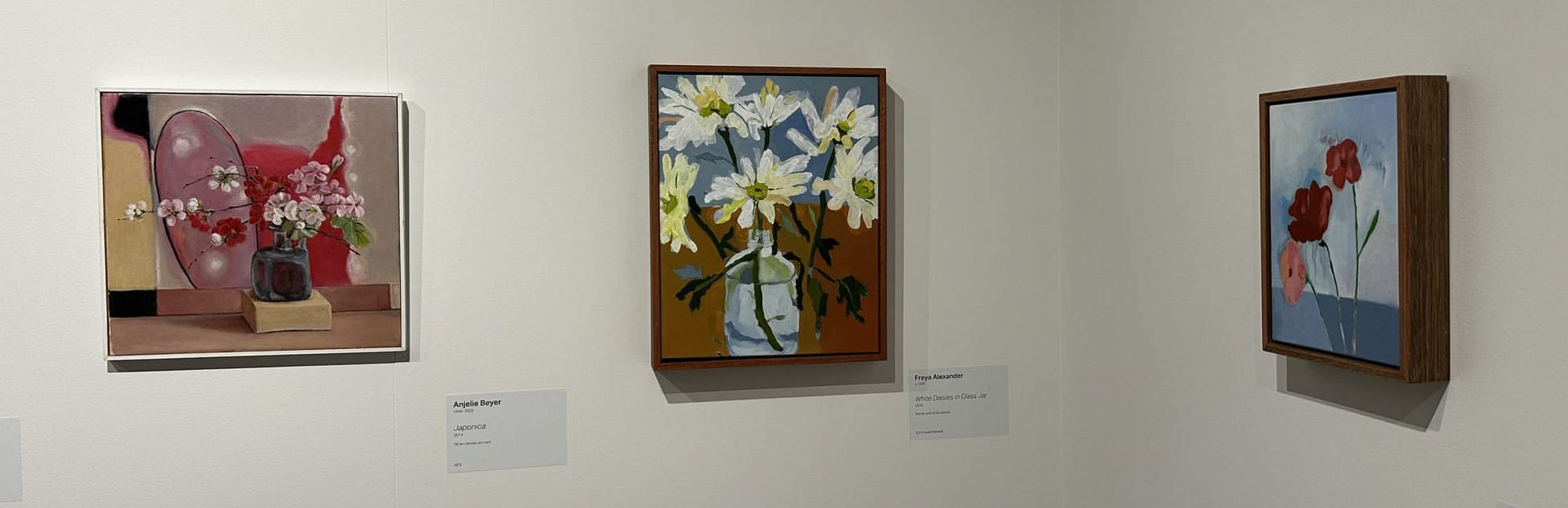
Delight in the world of flowers is a longstanding subject choice for artists. In this exhibition three generations of women have combined their efforts—and diverse approaches—to convey the emotions flowers elicit. Predominantly, I perceive joy, however this simplifies what is a nuanced exhibition with emotional heft. Some of this impact comes from the oldest of the women, Anjelie Beyer’s, recent passing and the knowledge that her daughter and granddaughter carried on this project which she was hoping to see completed.
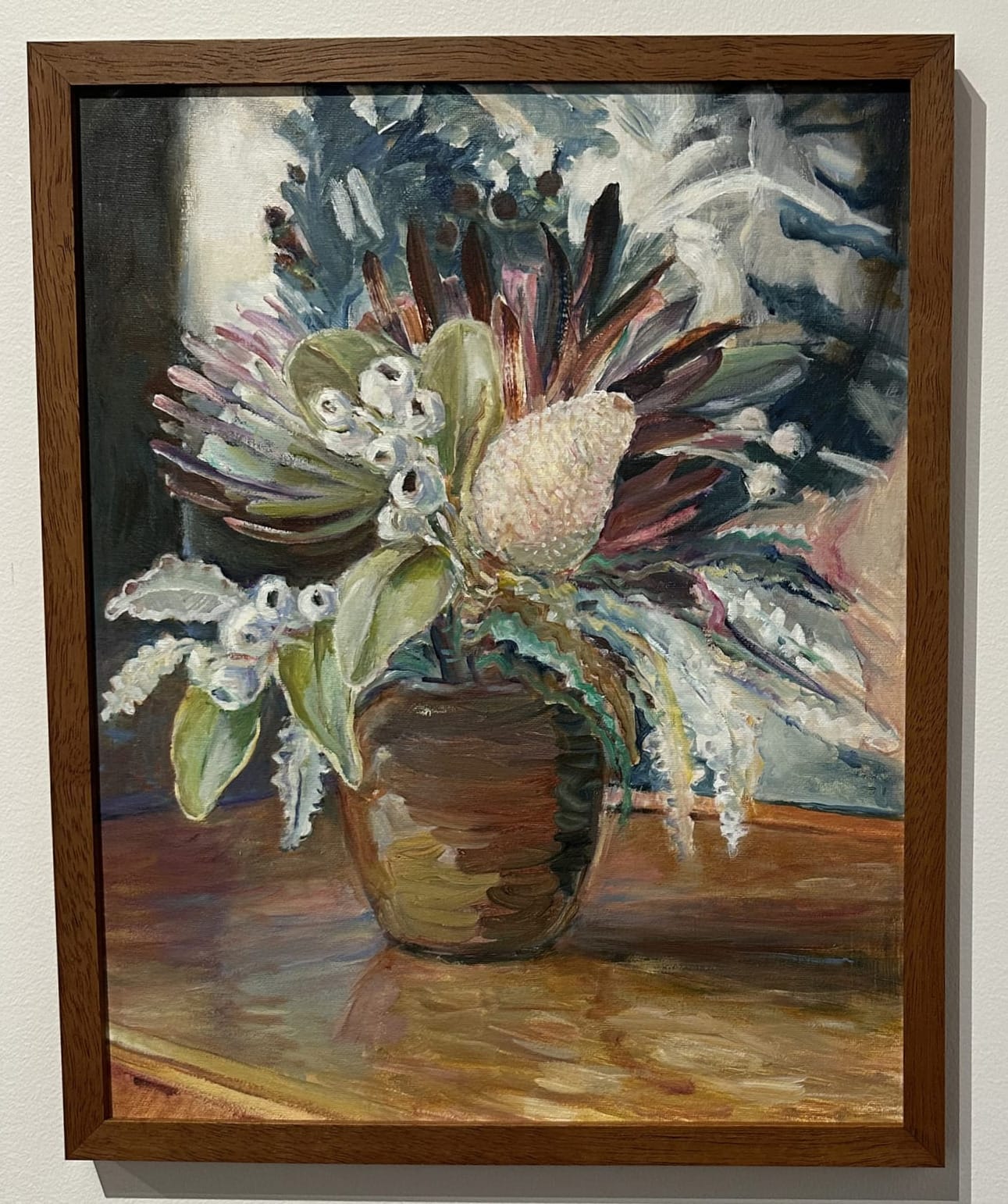
Anjelie Beyer’s long relationship with oils is evident in paintings of full bunches of flowers where we see attention given to the texture of petals, leaves, the vase itself as well as the reflective surface of the table. In Boy’s Bouquet (2017) the brown tabletop and earthenware vase create an atmospheric ground for soft grey proteas and gum nuts as well as red foliage. The composition has been thoughtfully put together. The vase is just to the left of centre allowing the blooms enough room but adding a sense of narrative drama by disrupting the symmetry. In the background an abstract wall hanging, also in silvers and greens, competes with the flowers meaning my eye is continually drawn to the vase and the table. Perhaps these are the real subjects here? The daylight hitting the table and the three dimensionality of the vase produced with thick brushstrokes in just the right browns evokes an assuredness that takes you along for the ride, no matter the subject.
Anjelie’s paintings remind me of Impressionist works in the way they make me look for a long time, wondering how it was done.
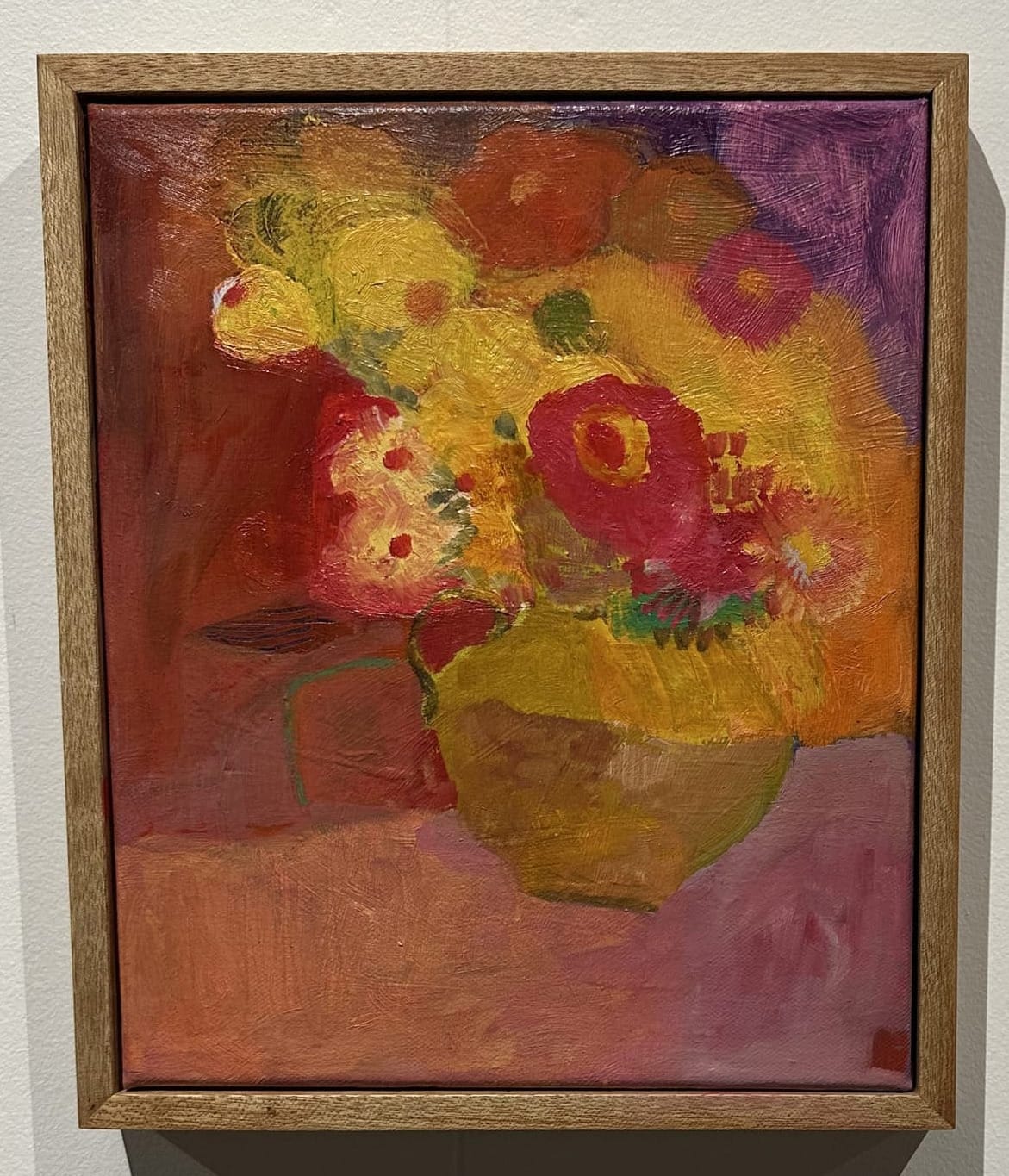
Her daughter Vonne Beyer takes techniques in a different direction. Instead of seeking to render the subject with precise but impressionistic details, Vonne’s work uses colour to create emotional impact. Her approach tends in a more abstract direction, one in which she seems interested in what the paint is doing on the surface of the canvas. The flowers in Little Dutch Jug (2025) are not all identifiable—perhaps they are daisies, or poppies or something else that says “flower”—but they glow yellow and they dance in the jug, surrounded by joyous pinks, oranges, purples and reds. Without resorting to comparing Vonne’s work to 20th century modernists, this work expresses emotion through colour in ways that shout Fauve, or Kandinsky. I don’t know what is Dutch about the jug, but this painting is jubilant and leaves the viewer in no doubt of the artist’s feelings for her subject.
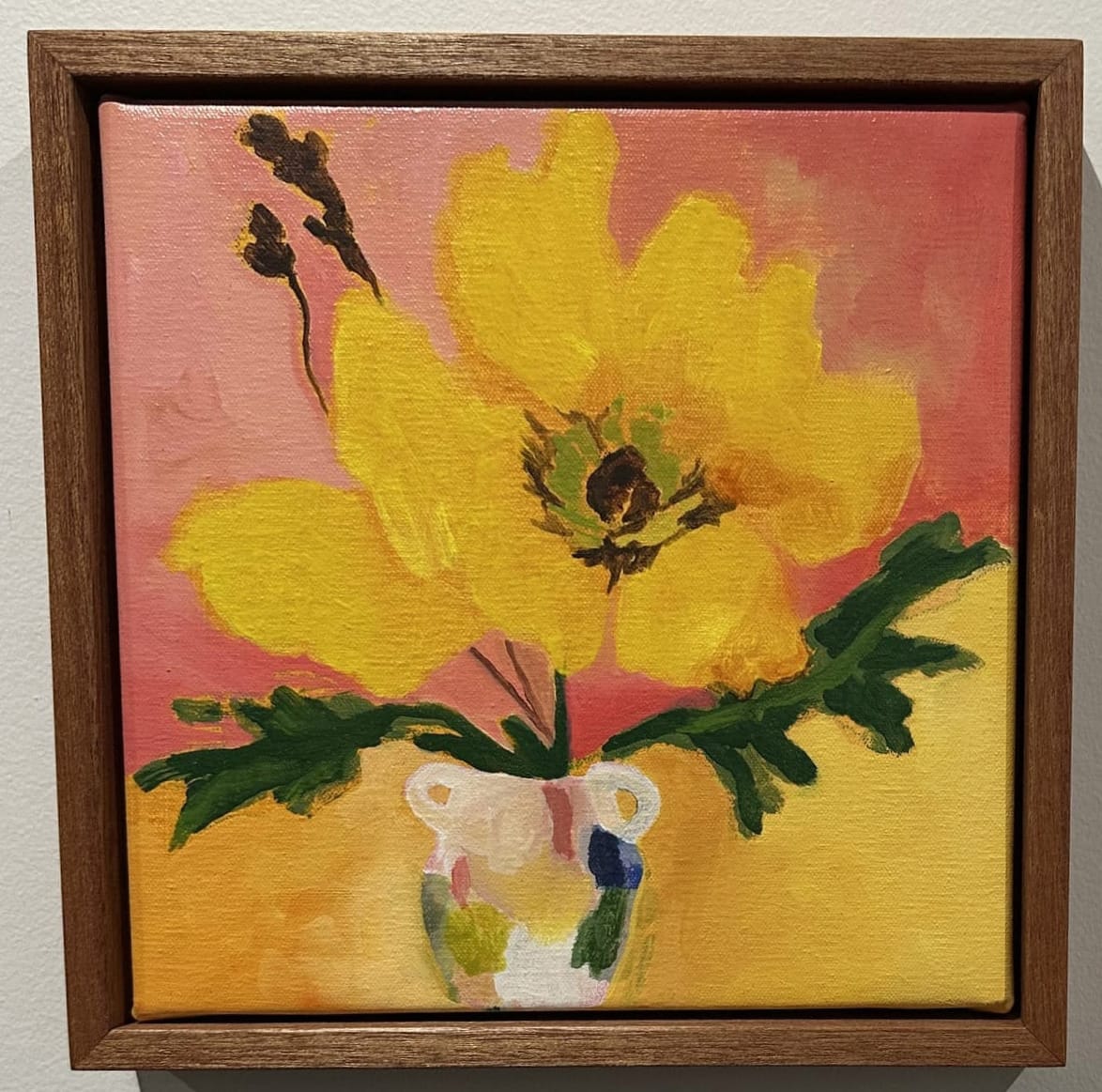
Freya Alexander is an emerging artist and her works, though small, build upon the abstract approach of her mother. A stylized treatment of flowers sees them sometimes out of their vases, singly or in groups upon contrasting backgrounds, or up close to emphasise colour rather than form. Freya’s brushstrokes are also as assured as her grandmother’s. In Rainbow Vase (2025) I see one yellow bloom with dark green leaves and a background of bright salmon pink, the petal edges blurring with the background. Pink and green are timeless, but the exchange between pink and yellow is the focus here, as well as in other works. The use of acrylic and oil adds a pleasant layering, convincing me the artist has been struck by inspiration rather than planning out the composition mathematically. It’s whimsy.
At the opening, paying homage to her grandmother, Freya called the exhibition a season of flowers. I’m reminded of the title Little Gardens of Eden. Each flower is a potential garden on its own, representing the potential of the whole through a single part. The seasons of life, like the decaying or overblown blooms seen in Dutch still life painting where flowers past their prime serve a momento mori function, are not visually present here, but the knowledge of Anjelie’s passing means that viewing this exhibition comes with unintended emotional impact. All three women have painted flowers at their peak, when their colours send out the most joy, when their shapes create the most humour or incongruity, when their contrasts are most inspiring and each does so with a different approach which makes this exhibition a pleasure to see.
Little Gardens of Eden is on display from 11 July to 13 September 2026.
In Gallery 3, next to these investigations of pleasure in the botanical world is another exhibition also featuring paintings of flowers.
Sue Clohesy, who was at one time a student of Anjelie Beyer, takes a closer look at the connection between interior spaces and arrangements of flowers and objects. Using acrylics on canvas, these works are larger in scale than the intimate selection in the neighbouring gallery. The blooms are a little brasher, and perhaps more expensive. The emphasis is more about capturing shapes, and forms, and textures in juxtaposition with the colours and patterns of surfaces like tiles, textiles, books, and other household objects.
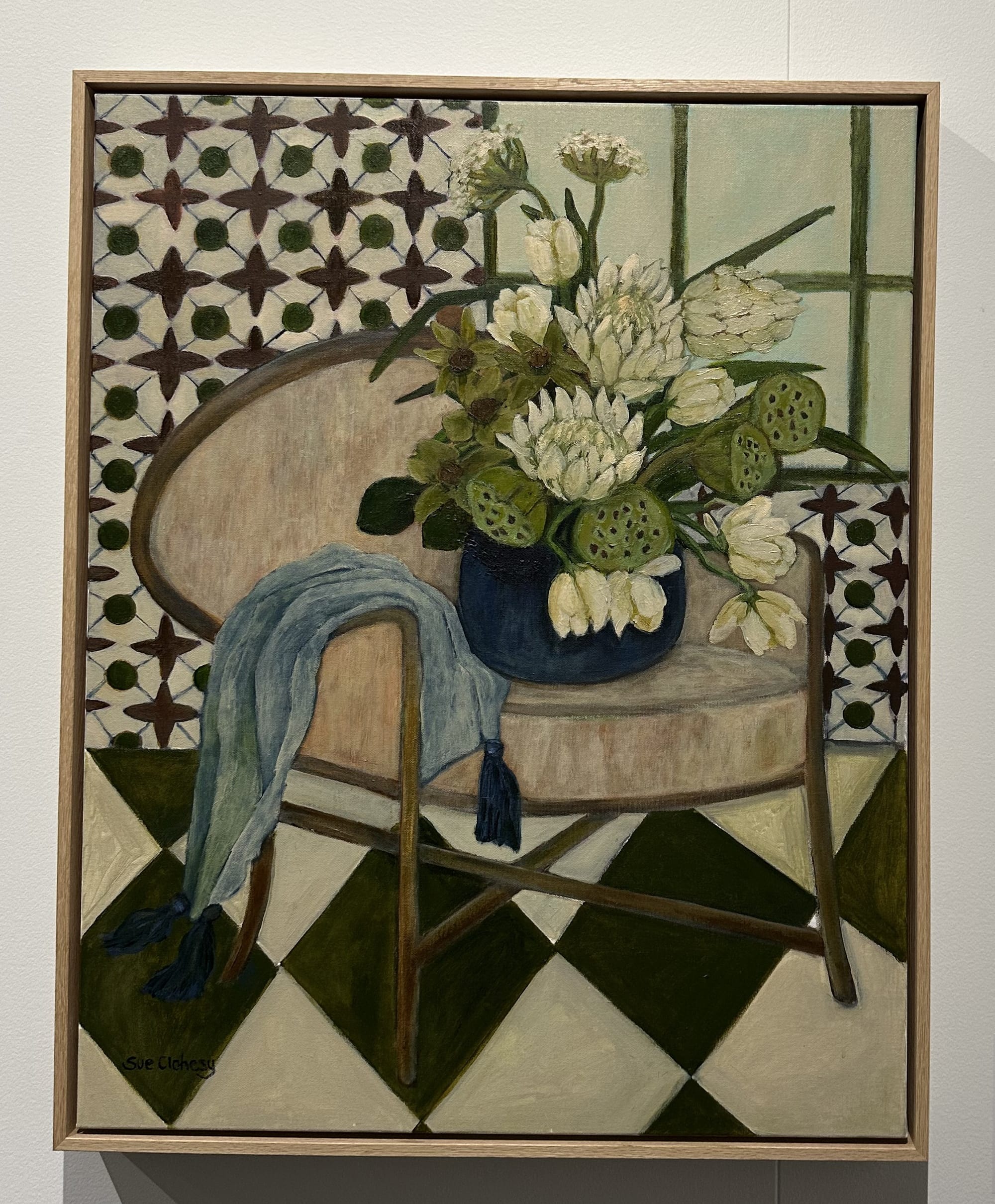
Sunny Corner (2026) encapsulates Clohesy’s approach at its best, I think. A tiled background meets a chair with a bunch of white proteas, lotus pods and orchids, perched somewhat incongruously on it, while the black and white diamond flooring falls at an extreme angle in the lower portion of the canvas. These things compete for attention and the eye doesn’t rest, they announce in equal volume: I am the subject. I think this is a bold, and somewhat Cubist approach, playing with the picture plane as well as texture and colour. I don’t perceive the sunny corner, instead my eye travels continuously and hungrily over the different components.
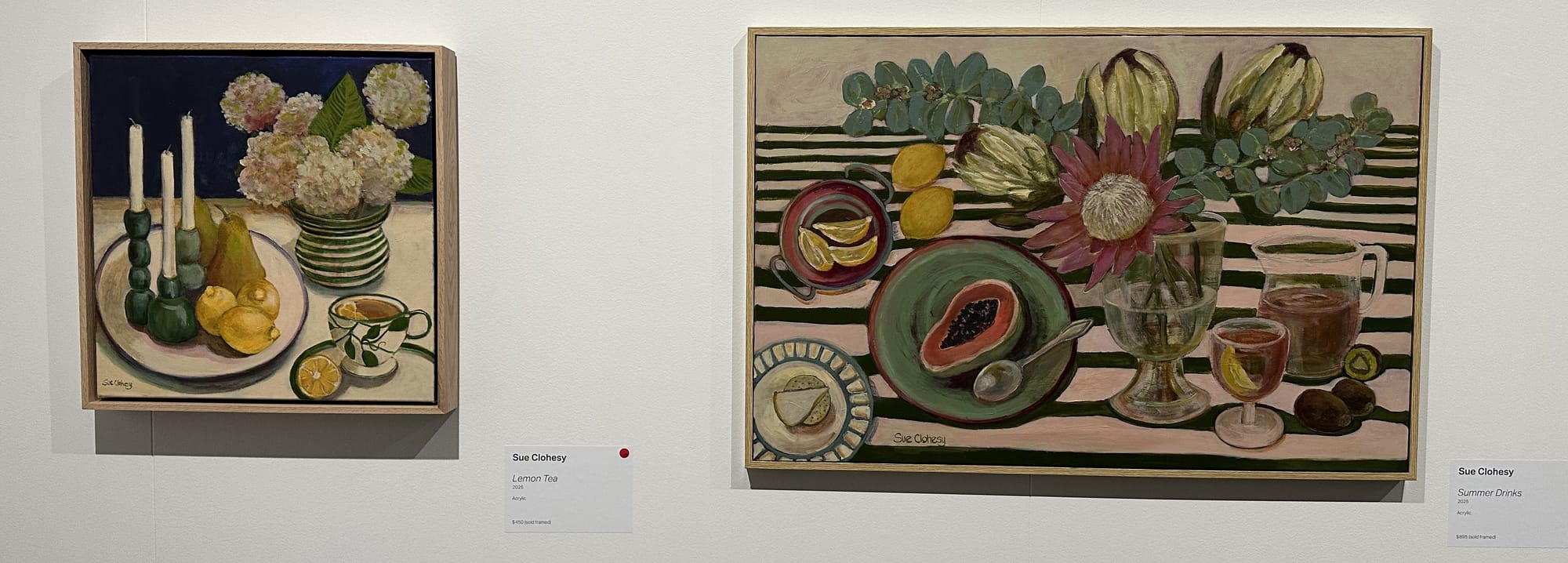
Spaces and Arrangements is also the product of Clohesy’s past experience in retail, where her evident eye for colour and texture was focused on an economic as well as aesthetic outcome. Her choice of colours in many of her paintings reminds me of a well put together shop window, the type that inspires the passerby to stop and wish their own house was equally sophisticated. I can’t recall an exhibition in which the influence of aesthetics on economics was explored in this way, and I don’t know if it is deliberate here, but I couldn’t unsee it.
Spaces and Arrangements is also on from 11 July to 13 September 2026.
The Mildura Arts Centre is one of those galleries with multiple and varied exhibition spaces. The result of an adjoining heritage house called Rio Vista, the ballroom is now known as Gallery 5. Visiting in July means leaving your coat on while descending the stairs into a chilly, long room with curved, sprung floor. Here a recent exhibition by another local artist, Neil Fettling, was displayed to coincide with the Mildura Writers Festival
Boinka is a word applied to shallow ground water depressions, or saltpans, on Mallee country between northern Victoria and the Southern Australian border. The word has a distinctly Aussie twang, depending on your pronunciation.
Using mixed media on a circular board, Fettling’s explorations of these landscape features stems from over three decade’s fascination with what he calls the ugly beauty of landscapes impacted by humans. This includes the impacts of tree clearing, agricultural runoff, and the overgrowth of algal blooms. For Fettling, our world is a modified one. The discs are bright fluorescent pink, an unnatural colour; while their surfaces are textural in an uncanny way. Fettling uses a range of oil and acrylic based paints, water and sawdust which react to each other creating these alien yet familiar landscapes.
In a public talk during the Mildura Writers Festival, he noted parallels between the landscape surface and the surface of human skin, where scars, scratches and histories of disease might be written. His wife was diagnosed with breast cancer while he was creating the series and he reflected on the connections between cancer, polyps, and the way in which what we do to nature we also do to ourselves. Hot pink is also often used in breast cancer awareness campaigns.
The subject of these circular works is unequivocally bad Country, a term used by Gudanji/Wakaja author Debra Dank during the Writers Festival to describe places where chemicals used by fracking companies, as one example, render a place uninhabitable to non-human kin, that is all the life forms that we can and cannot see whose home it is.
Legend and Writers Festival speaker Bob Brown also spoke about Fettling’s artworks. He said these unsettling, pink, and blank spaces show us where we are headed if we don’t love ourselves and the planet in the way that is required to alter the course we are on. By this he means living within the bounds of what the planet can provide, taking the foot off the accelerator and making some compromises. His words shortly after, during the annual Murray Talk, detailed these ideas with such power and hope, showing that his life of activism has proved that action is the only useful antidote to anger and depression. Anger and depression, he noted from personal experience, are something we’re bound to face if we pay attention to what is happening to the planet.
I was profoundly moved by Bob Brown’s talk in a way that made me feel I had grown up listening to his moral guidance. Maybe I had. I like to believe my hometown was that type of place. His framing of the environmental crisis and what he called the noble duty to act for the only planet we have, was like hearing a familiar song, but I needed to be reminded of the lyrics. He did this and then some.
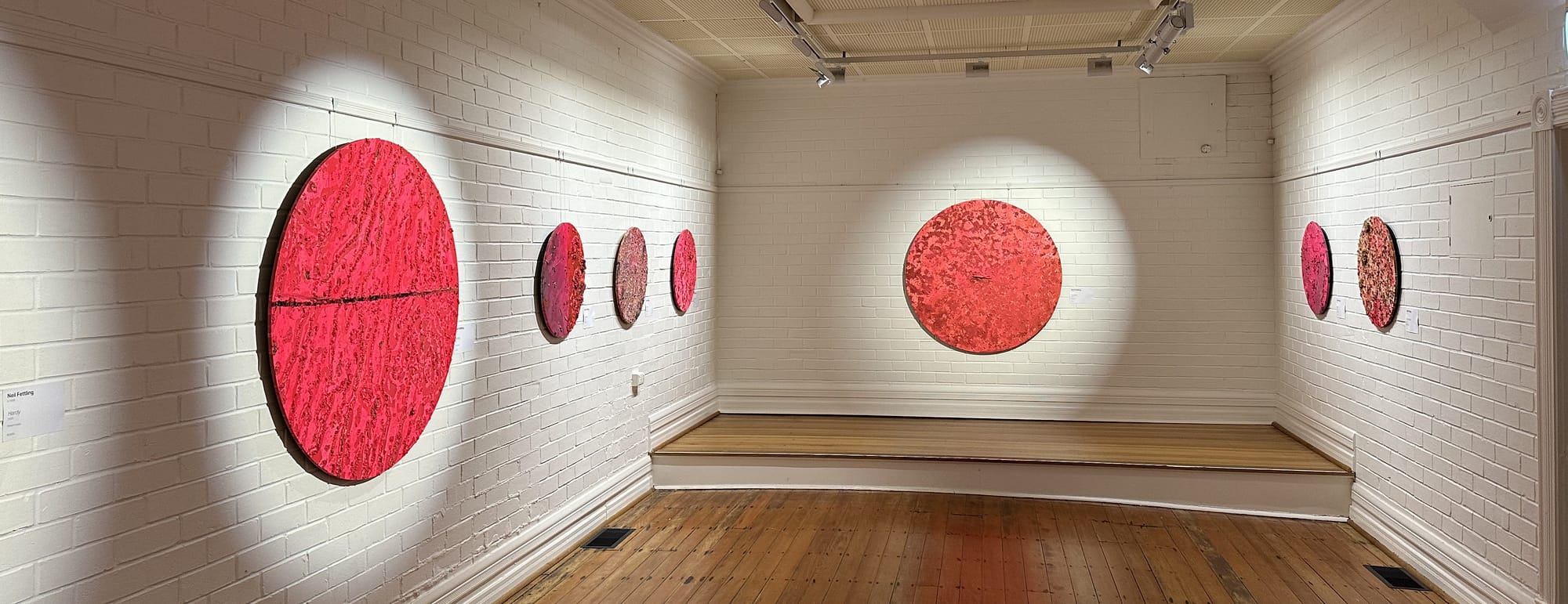
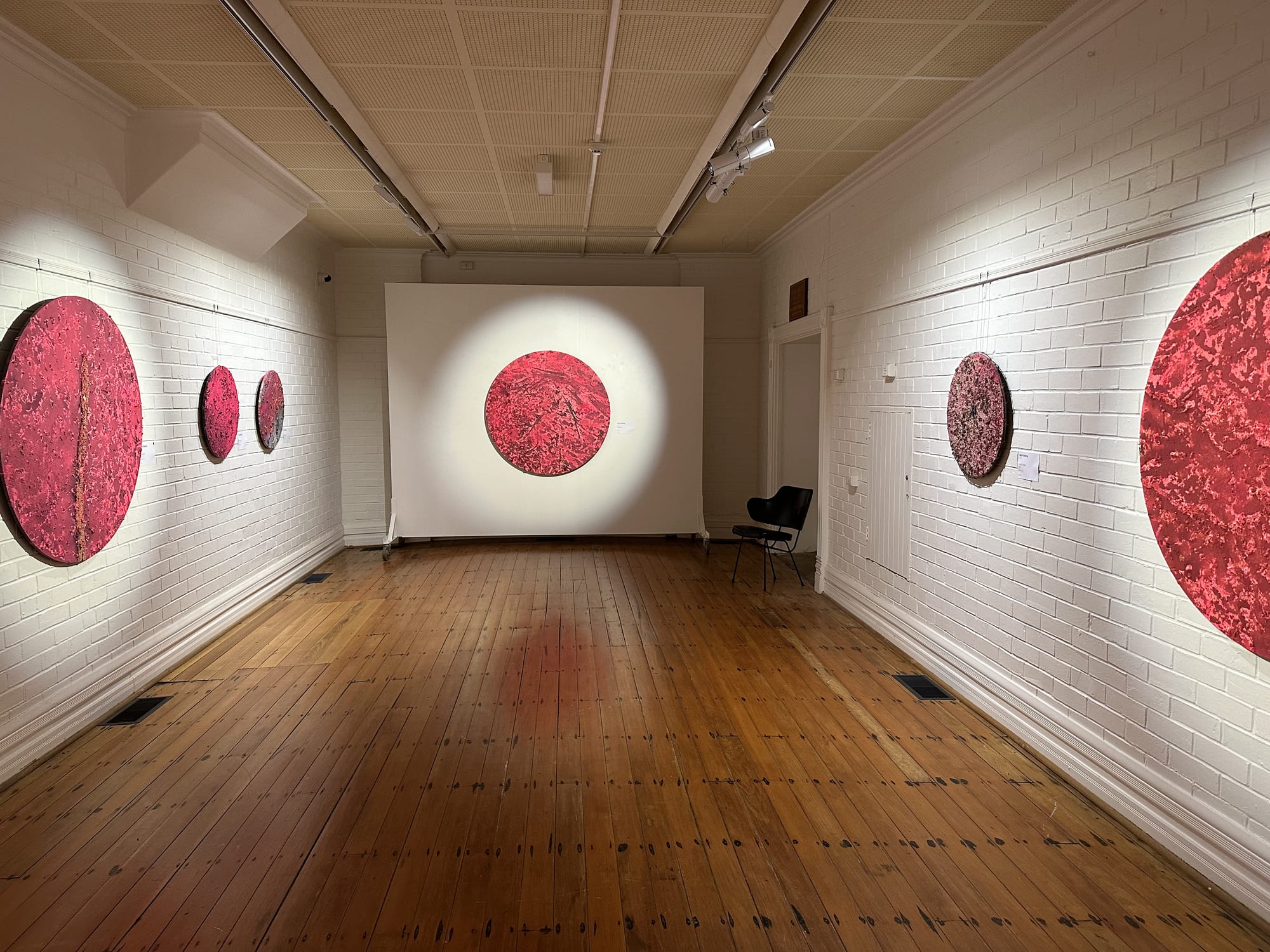
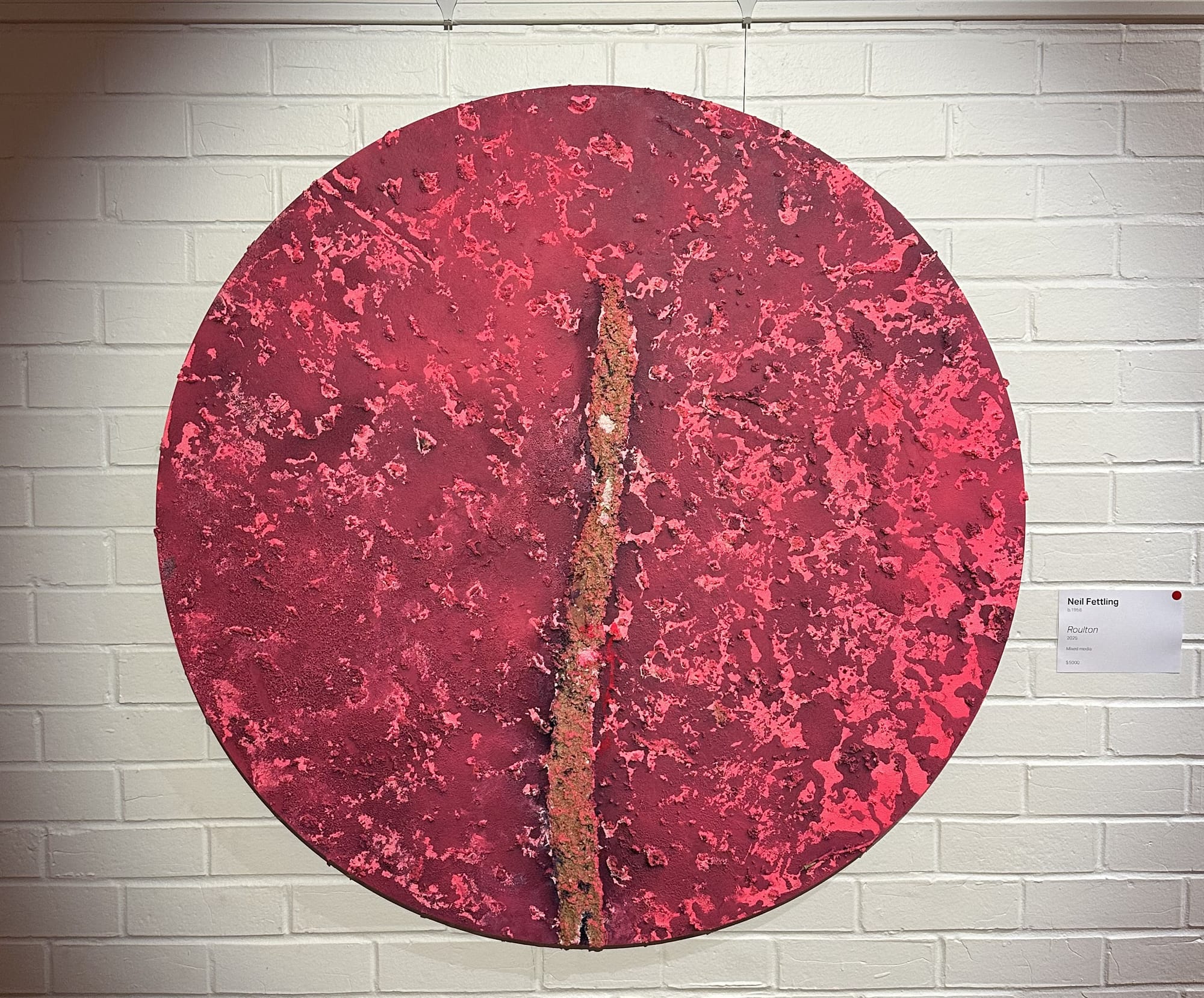
The installation view of Boinka.
Boinka concluded on 19 July, but more examples can be seen on Neil Fettling's website.
More information on taking action, visit Bob Brown Foundation.