Where do First Nations portraits belong in a thematic exhibition?
Portraiture is a worthy and rewarding genre to explore many issues, including gender and ethnicity. Ironically, this exhibition left me wondering where some women fit.

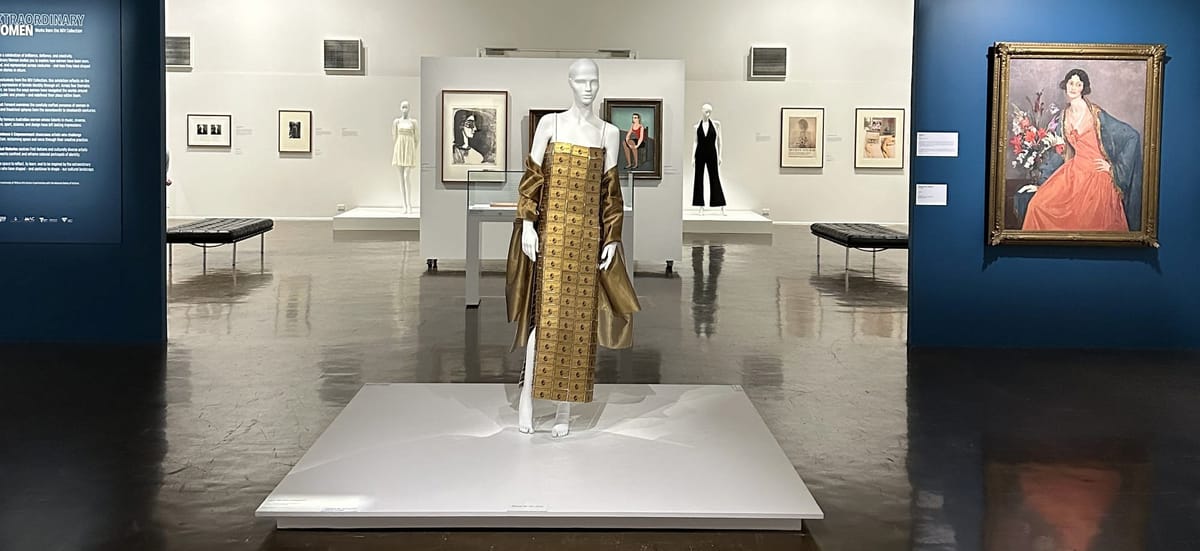
Exhibitions surveying large time spans can struggle to place First Nations subjects in the narrative without it appearing like a performative add-on. The National Gallery of Victoria’s (NGV’s) current touring show, Extraordinary Women, seems confronted by this question. A portraiture survey of women, it explores their contributions thematically across time. From 1700s to the present, the exhibition features photography, painting, textiles and some small sculptures.
As a touring show this exhibition attempts the difficult task of covering ~400 years of women’s roles and representations, while also including enough different media to keep the viewer interested. Curated from the NGV’s collection and displayed in the Mildura Arts Centre’s compact ground floor galleries, this is no easy task.
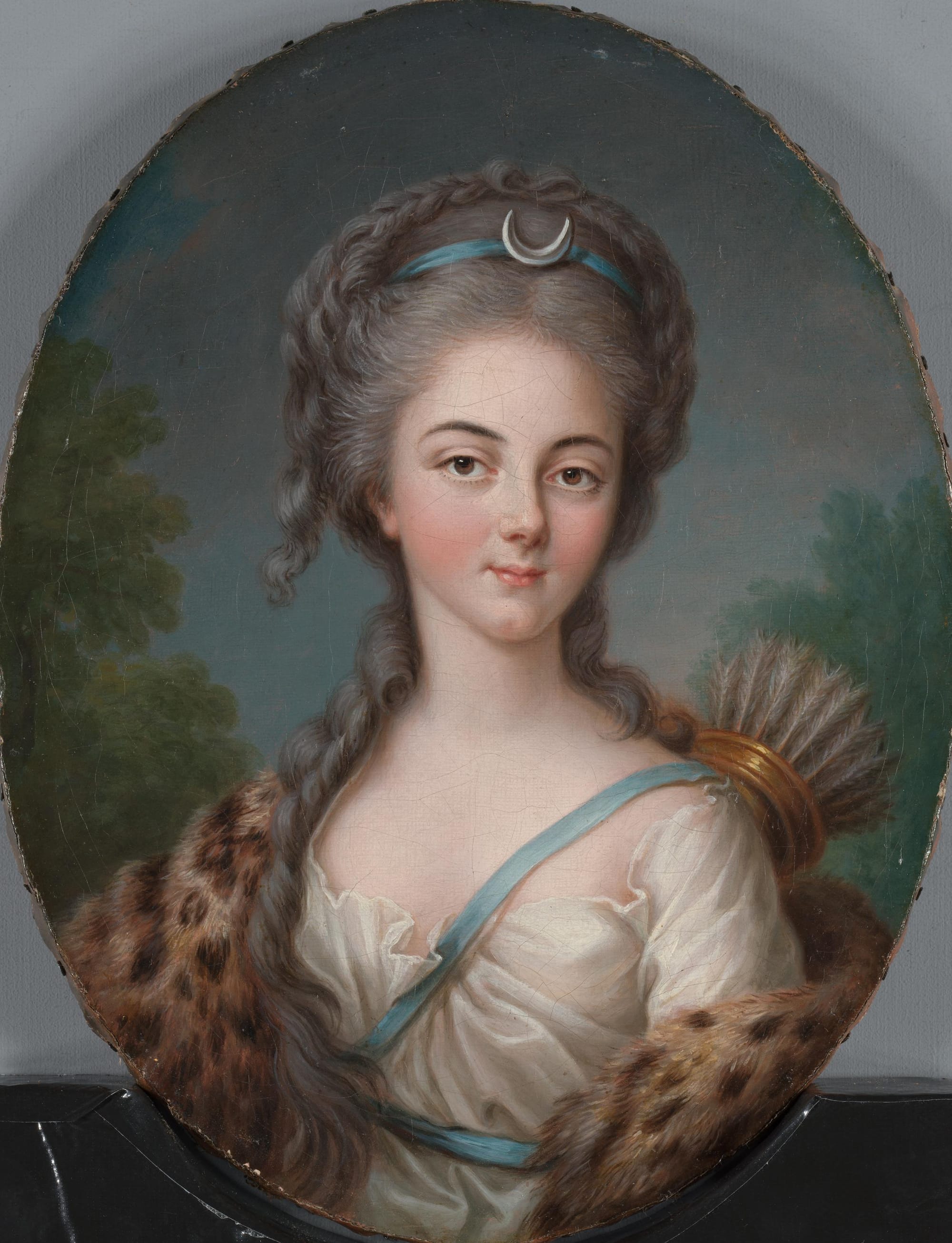
The exhibition opens with a selection of oil paintings showing women putting their “best foot forward”. As the wall text spells out, the connections between each work on this wall is a woman’s appearance, which spoke louder than her voice in 17th and 18th centuries. A portrait of a young aristocratic woman by the young female artist Elizabeth Louise Vigee Le Brun, painted around 1775, exemplifies beautiful symmetries in women’s lives at the time. An ornate gold frame encircles this portrait of Anne Charlotte of Lorraine, dressed as Diana goddess of the hunt. Her hair is a tall grey wig, and she carries a quiver of arrows over her Leopard fur-clad shoulder. One eyebrow is raised saucily, with the artist capturing just enough knowing in her looks while still being respectable. How many young women could practice as artists at this time and enjoy the camaraderie of painting an equally youthful face? It’s the stuff historical romances are made of…
The wall text alerts me that Le Brun became a favourite portraitist of Queen Marie Antionette, and this one was for many years in the collection of Princess Diana’s stepmother. More symmetry: Diana of the hunt, the subject of the painting, and Princess Diana, a hunted celebrity. The viewer might wonder why these details are necessary to include and I fear, alongside the enlarged text summarising the content of each thematic section, a tendency to tell the viewer what they should gain from looking prevails.
Still, the right amount of accompanying text enriches the imagination.
Jumping from these old international examples of women in portraiture, the next wall features portraits focused on the theme of celebrity closer to home. This theme ties together a selection of photographs and paintings of Australian women whose “talents in music, cinema, literature, sport, science, and design have left lasting impressions”. There are familiar faces like Dame Nelly Melba and Henry Handel Richardson (Ethel Florence Lindesay) alongside less well-known women. The selection is shaped by the NGV’s collection itself, and the results, ironically, shouldn’t be assessed on notoriety or profile. I knew only a few of these women, so the term celebrity was perhaps misplaced, but it does conjure high profile figures from the past which we see here.
The black and white photographs by Athol Smith of Maureen Jones (pianist), Mavis Ripper (dressmaker) and Elke Neidhardt (actor and opera director), are beautiful examples of glamorous 1960s elegance. Not a hair out of place and just a hint of the dramatic. His portrait of writer and editor Mary Mitchell is more honest and human.
Again, the exhibition felt didactic here, lots of ‘tell’ and not enough room for ‘show’. It may be true that “these images celebrate not only achievement, but the power of being seen, remembered and revered”, but women’s achievements end up the ugly sister under the flashbulb of appearance.
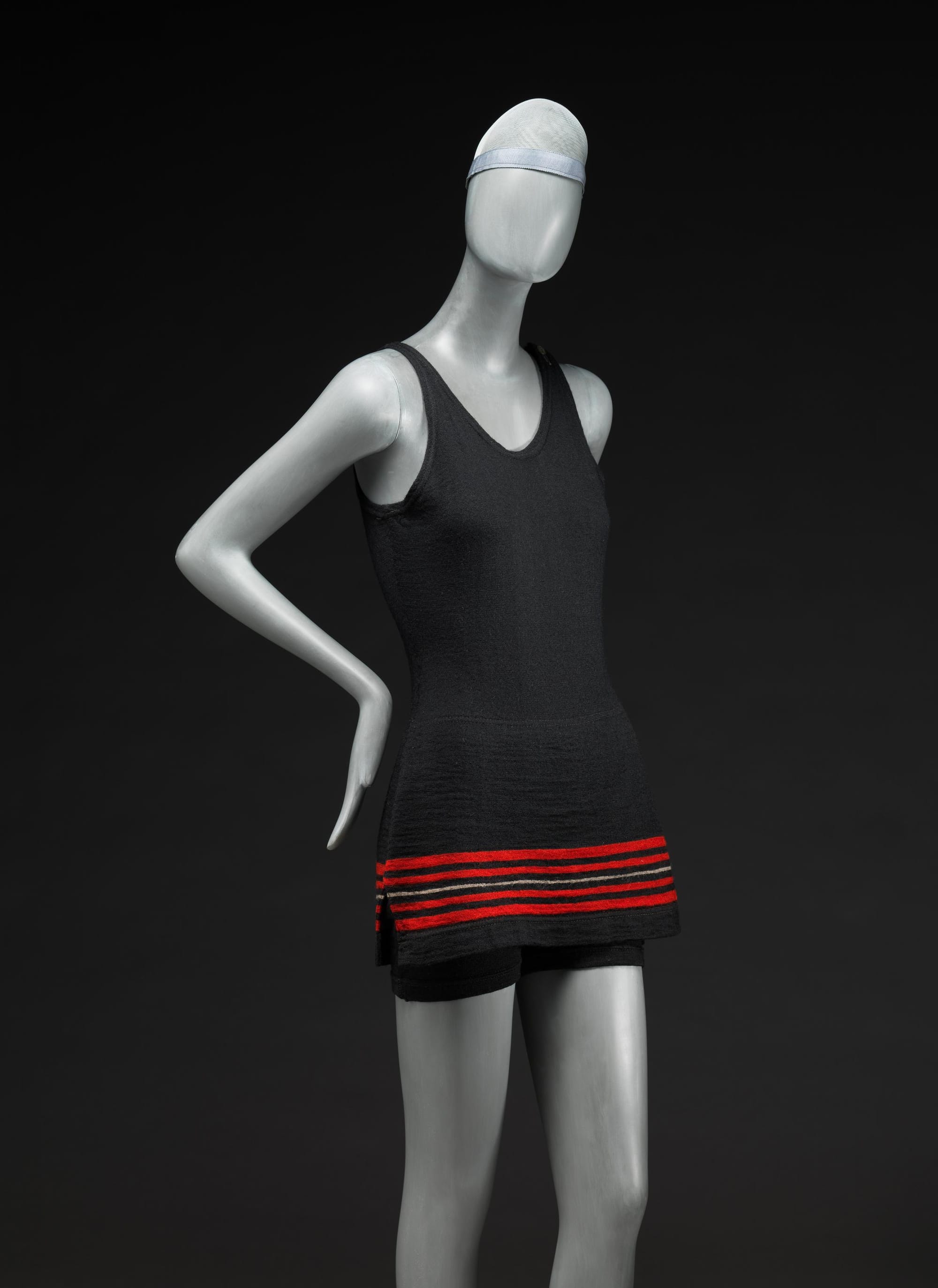
The American Express Gold Card dress (1995-1998) by Lizzy Gardiner emphasises this with it’s simple yet iconic form, while nearby swimming champion and vaudeville entertainer, Annette Kellerman’s swimsuit in black wool (c.1920) does its utmost to steer our attention from appearance to skill and achievement. The tension between these two elements is probably the most interesting part of the first room of Extraordinary Women.
Independence and empowerment frame the third section, a logical and obligatory counterpoint to celebrity and appearance. Subjects in this section are here to remind the viewer in stronger terms than the preceding works that women were and are talented beings, capable to regard for something other than how they look. Claiming space and challenging convention are celebrated here in the lives and art of Prue Action, Carla Zampatti, Ann Newmarch, Bea Maddock and the Guerrilla Girls among others.
In spite of the reductive framing, I found many of the portraits in this section worth spending time with. There were more paintings here – from 19th century until the present and from beyond Australia – allowing for an expansive overview of unconventional women. This section could have formed the foundation of an interesting exhibition in itself, had it expanded the definition of ‘woman’ more widely.
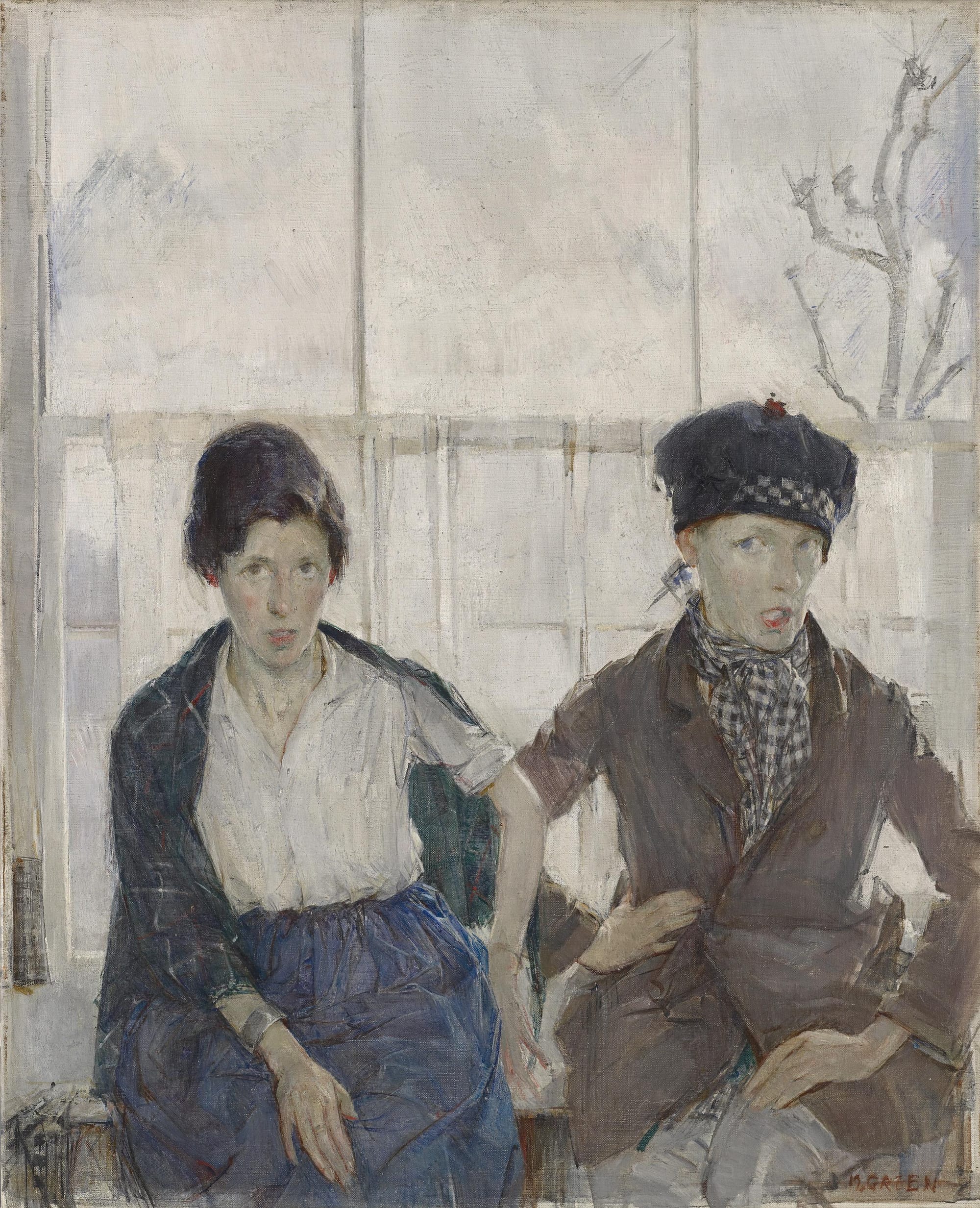
I enjoyed Madeline Green’s double portrait Glasgow (c.1930), for example, which was thought to represent a young man and woman when first exhibited, but to modern eyes the two women posing are unmistakable. The direct gaze and confident stance of one figure in masculine clothing contrasts with her companion’s hesitant look. The work has a timeless quality and is almost a masterclass in gendered body language captured in loose, expressive brushstrokes. Glasgow also beautifully evokes place and women’s evolving roles in the early 20th century.
It is on the opposite wall in the second room that the exhibition struggles thematically to accommodate First Nations and culturally diverse women. The NGV’s collection includes rich examples from which the ‘Embodied Histories’ walls are curated. Unfortunately, the chosen selection is reduced to “confront[ing] colonial frameworks” which limits the possibilities, ironically, of the chosen artworks speaking back to history. Had they been woven throughout the exhibition the viewer might have garnered a deeper experience of First Nations and culturally diverse women’s identity.
With the exception of Christian Thompson’s portrait of Professor Marcia Langton, the majority of the works in this section are united by a delicious sinister undercurrent. TextaQueen (born in Perth and of Indian heritage) is represented by self-portrait with grinning fluffy monster playing puppet master. Tracey Moffatt’s cibachrome photograph of small-town life, and Peggy Napangardi Jones’ self-portrait as a matriarch you wouldn’t want to mess with (a similar energy to Krystle Evans’ work) take a sharp look at the genre and produce something which hums with possibility beyond appearance. In these works the word portrait fails to encapsulate the power expressed (in much the same way the legal system fails to recognise Aboriginal lore/law in Peter Weir’s film The Last Wave (it was airing yet again on SBS at the time of writing)).
Jenny Watson’s evocation of domesticity, located in the middle of these works, is an odd one out. Playful layering of narrative fragments, signaled in the title A woman’s work is never done + I feel like when my father used to dry my hair (1992) resonates on the level of suburbanity with Moffatt’s and TextaQueen’s but mostly exemplifies an unusual portrait.
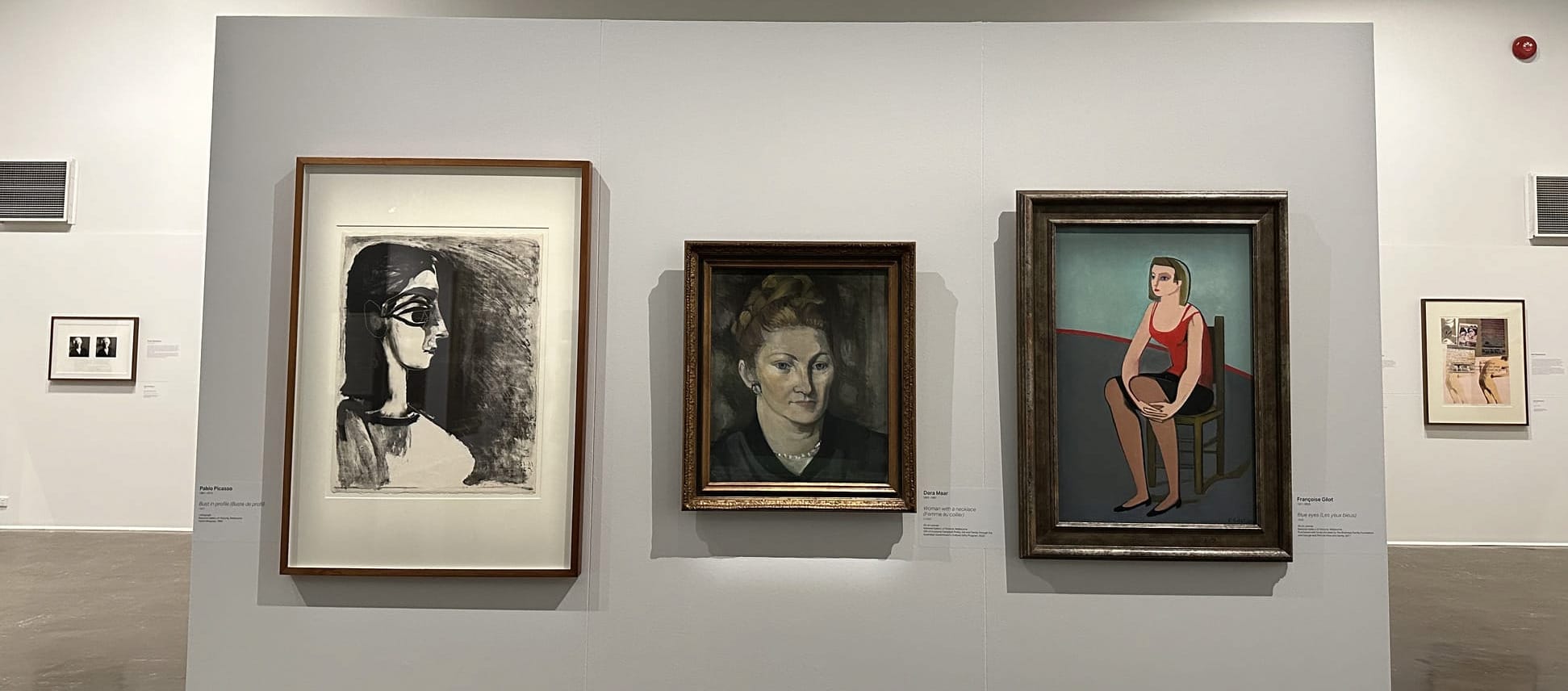
A final selection of portraits includes two sculptural pieces in terracotta and a lithograph by Pablo Picasso. (Was Picasso’s famous Weeping woman too expensive to loan?) Alongside Dora Maar’s Woman with a necklace (c. 1950) and Francoise Gilot’s Blue eyes (1956) they evoke avant-garde 20th century portraiture. This isn’t out of place in this exhibition, but, oddly, there isn’t much information about Maar and Gilot, for example. I will conjecture my own reading: if portraiture in the present cannot be separated from politics, these works from the mid-century are focused on the psychological world of the sitter.
As a whole the exhibition does its best to meet an incredibly difficult task. The works by First Nations and culturally diverse artists are just so compelling that they appear to exceed all thematic considerations, while also seemingly reduced to their diversity category. This is disappointing. I would also have liked to see the exhibition contend in some way (playfully? Politically? Poetically?) with trans women’s identities without falling into the sectioning off approach that was applied here with First Nations and culturally diverse women.
To be frank, sectioning off the Other women (and excluding Queer or gender non-conforming women) is insulting to the audience, and it reinforces notions of whiteness as the default acceptable category, while simultaneously undermining the premise of the exhibition: empowerment and success, talent and contribution to society.
Am I surprised that such a sanitised selection of the NGV’s collection would be organised for Mildura? Perhaps not, but I am disappointed by several missed opportunities. I believe Sunraysia's audience is smart and diverse but maybe don't feel welcomed by this type of exhibition programming? A wealth of options are available looking no further than the catalogue of the 2022 NGV Queer: stories from the NGV collection.
The exhibition is on display 26 Oct 25 – 1 Feb 26, free entry. Portraits: Past to Present showcasing works from the Mildura Arts Centre collection is on display until 15 February.
Post script
This newsletter is currently free, but you'll agree all writers should be paid for their work. Slow Looking is an independent publication, you're likely reading this because you're interested in my perspective, unaltered/uninformed by AI LLMs or institutional guidelines. It's a frontier out here, in more ways than one!
Here's the pitch: Slow Looking presents art criticism from the inland, with occasional jaunts to the coast. To my knowledge there are very few independent publications covering this particular corner of culture. (It's also important to support others out there who receive state and federal funding, have subscriptions etc, but I'm doing this off my own canoe.)
I would like for this venture to break even, and so in the future there will be a way for you to help cover the internet hosting costs, and even remunerate the author! Brilliant!
In the meantime, one way to support Slow Looking is to share this newsletter with friends you think might enjoy some writing from the actually inhabited inland. Even better, if you know folks in a position to commission me to write something, send this their way. I would be exceedingly heartened!