Review: The Jacaranda Art Prize
The Jacaranda is a favourite tree in many parts of Australia. Synonymous with spring, it’s a favourite spectacle of the Instagram photographer. This is a lot of hype for a tree that isn't even native to this continent. In Mildura the purple carpet maker is honoured with an annual art prize.
The Jacaranda is a favourite tree in many parts of Australia where it's celebrated with festivals and events. Grafton in NSW has made a name for itself and its many street-side plantings with ten days dedicated to all things Jacaranda. Herberton in Queensland also has its own festival. Synonymous with spring, Jacarandas are a favourite spectacle of the Instagram photographer across the country.
This is a lot of hype for a tree that isn't even native to this continent. (It's longer, colonial history, has been detailed by Susan K Martin in Australian Geographic.)
In Mildura the purple carpet maker is honoured with an art prize in October-November when the tree blooms across the region.
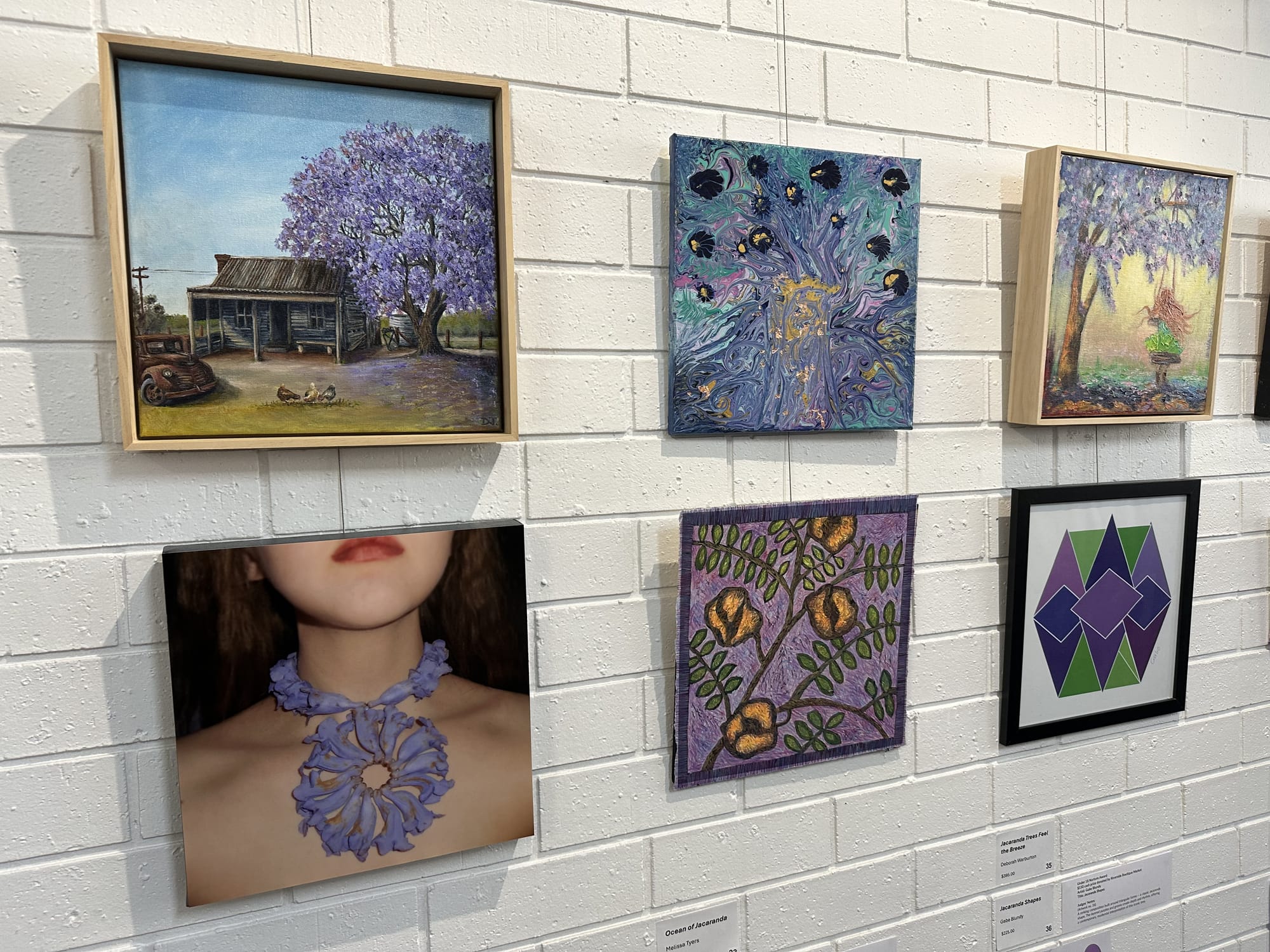
Workspace 3496 +Gallery has been presenting the prize and exhibition since 2022 featuring predominantly local artists. Works are set at 30x30cm in any medium and this year's hang reveals a skilful presentation of wide-ranging interpretations of the iconic flower, symmetrically regulated by the size restriction.
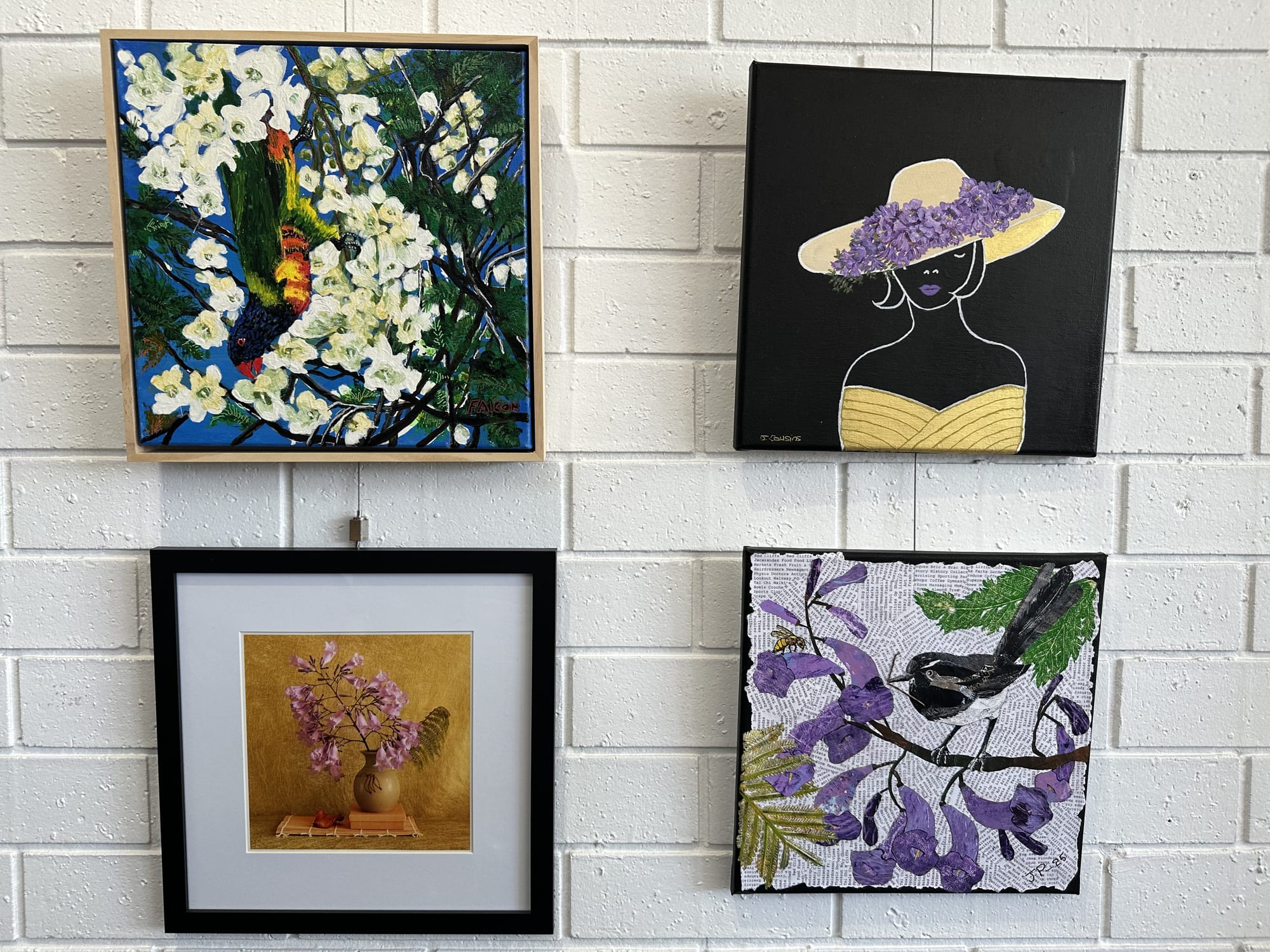
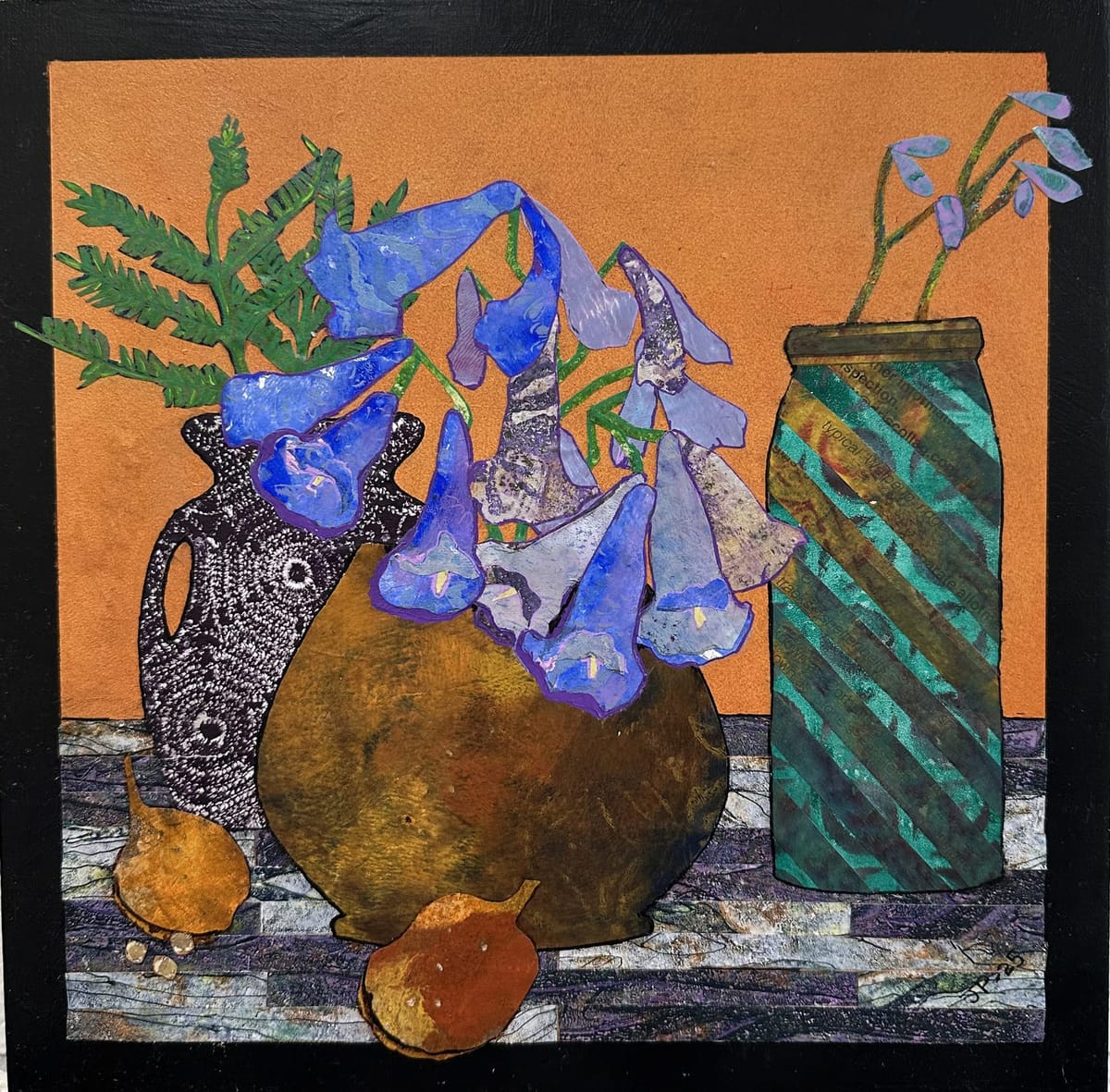
What prevents this exhibition from being a sea of violet rinse is the range of mediums used as well as the multitude of styles deployed. Some artists have opted for traditional, representational depictions of Jacaranda Mimosifolia. Deidre Jaensch's A Casual Arrangement depicts a stem of the flowers with accompanying tiny-leaved foliage and seedpod standing in an earthenware vase against an off-white background. The details of the leaves and flowers are pleasingly accurate, including a few dropped on the plain table surface, and subtle shadows adding realism to the picture which is squarely a still life with a nod to botanical illustration and memento mori. Jaensch won the Best Classic Jacaranda award with this painting, and I can see why. It has all the elements of the Jacaranda, down to the immediately wilting foliage.
The purple princess is not known to be a good cut flower for this reason, which challenges artists painting from life.
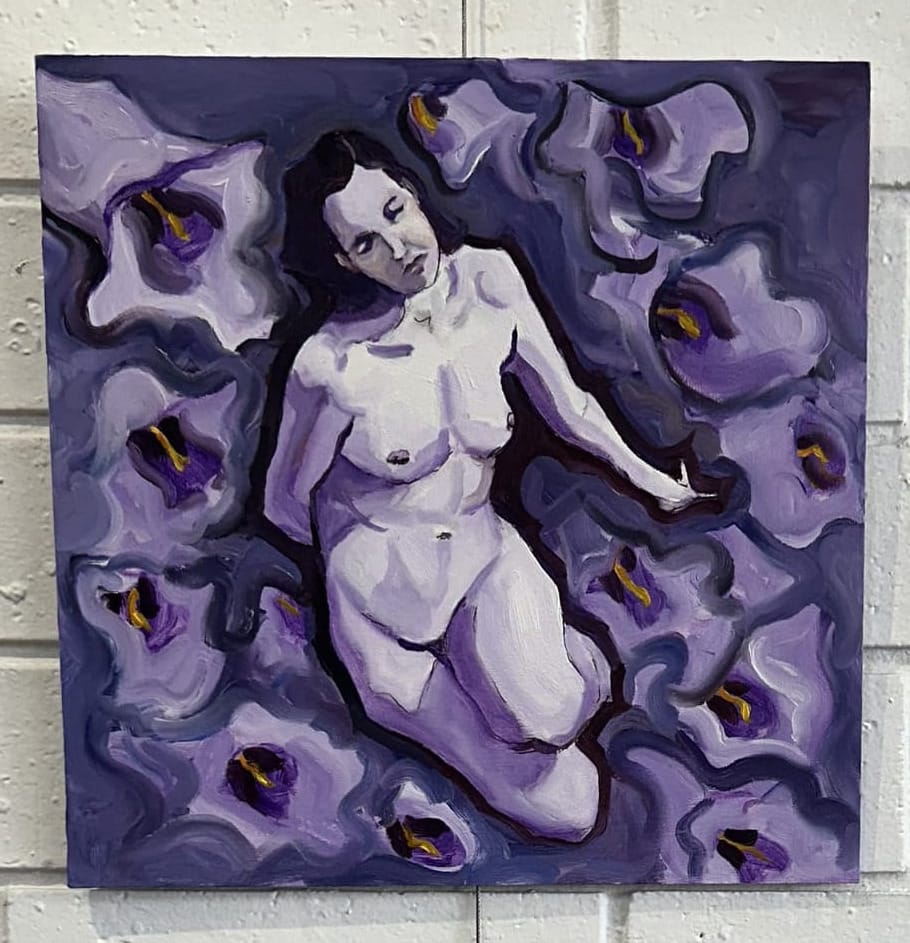
Many chose more abstract, interpretive approaches in other genres to address this challenge. Tim Williams's Night Bloom is a nude, viewed from a high angle, her eyes closed she relaxes surrounded by larger-than-life Jacaranda flowers. They float in single melting shapes around the woman, their yellow stamen-ed throats becoming suggestive in this context. Williams took home the Best in Show award which – as the only nude – may encourage other artists to think symbolically with their interpretations.
Keeping in the abstract vein but introducing contrasting colours, Rhonda Avery's Jacaranda Elements was not unique for pairing violent with orange to explore pieces of the purple profusion, but it nailed the difficult terrain between representation and total stylisation. The flowers themselves take a backseat to Avery's depiction of the seedpods as dark, dynamic shapes against an apricot background. Gold outlines and paired-back Jacaranda tubes appear to wiggle across the surface of the canvas like lively purple tadpoles. The judge's commented that it was the use of complimentary orange and purple that made the flowers and seed forms pop, and the work was awarded a highly commended.
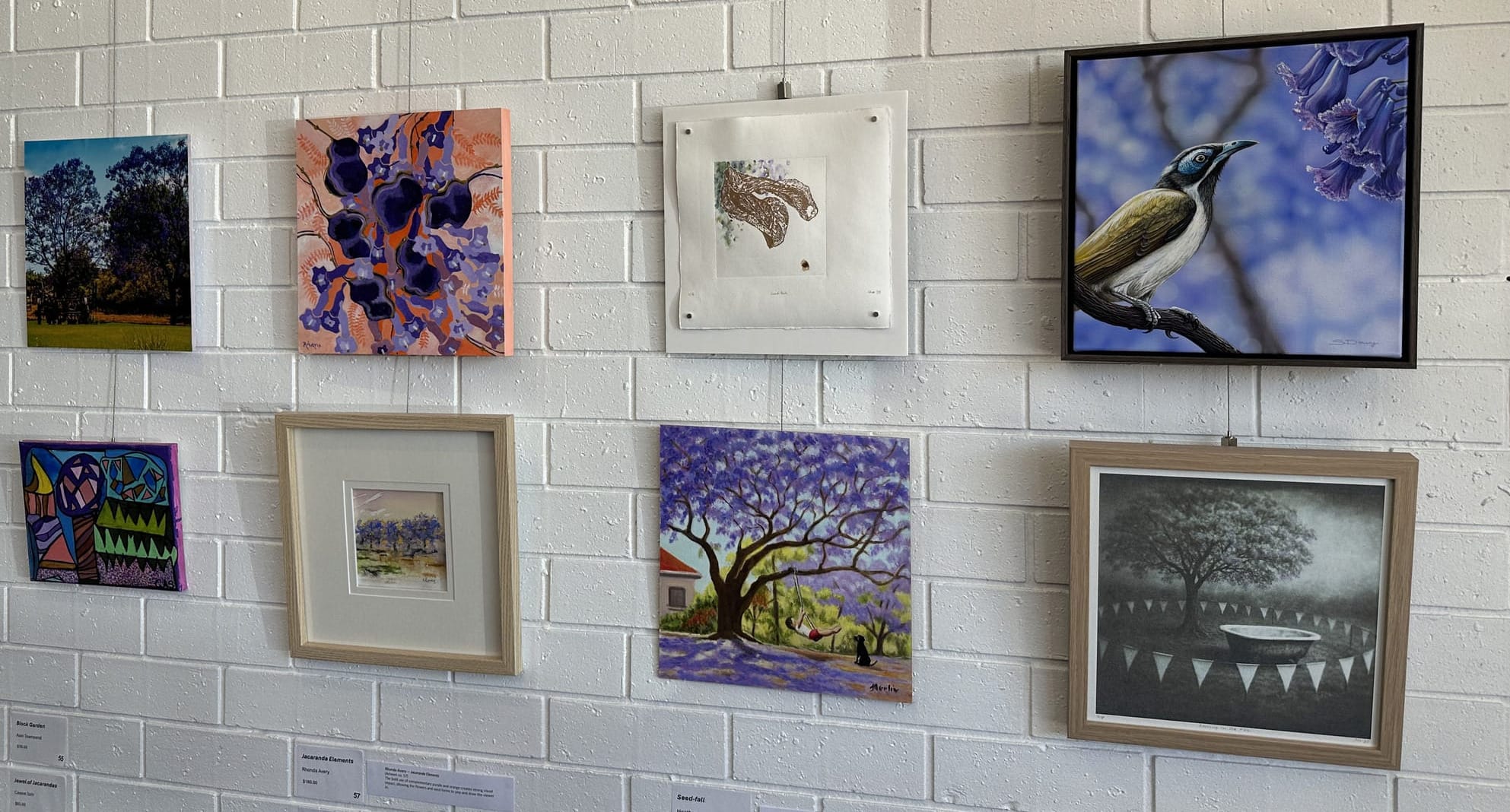
Heather Lee's Seed Fall, hanging to the right of Avery's work, was also highly commended. A print maker whose recent solo exhibition at Workspace 3496 explored the popularity of women's cricket in the region in the early 20th century, this work is recognisably Lee. One of only a few works to embrace the negative space, Seed fall is a detailed print in gold of a seedpod with very subtle watery hints of Jacaranda in the background.
By attaching the work to a backing board with magnets, Seed fall appears to bring its own gallery wall with it. I thought this was an interesting approach, instead of framing the piece, Lee adds another layer of white. Her technique spoke to the judges, proving that purple does not need to be the overriding element in an artwork about the famous purple tree. Where would we be without the seeds themselves?
Another printmaking example which brought to mind the lifecycle of the Jacaranda was Win Moser's White Browned Babblers in Jacaranda Tree in watercolour and monoprint on paper. This work is charcoal grey with the Babblers’s confident outlines defined against a warm, beige background. Though the tree is not recognisable – there is none of the eponymous colour – Moser’s birds express another important dimension of the subject. Where would the seeds be without the birds?
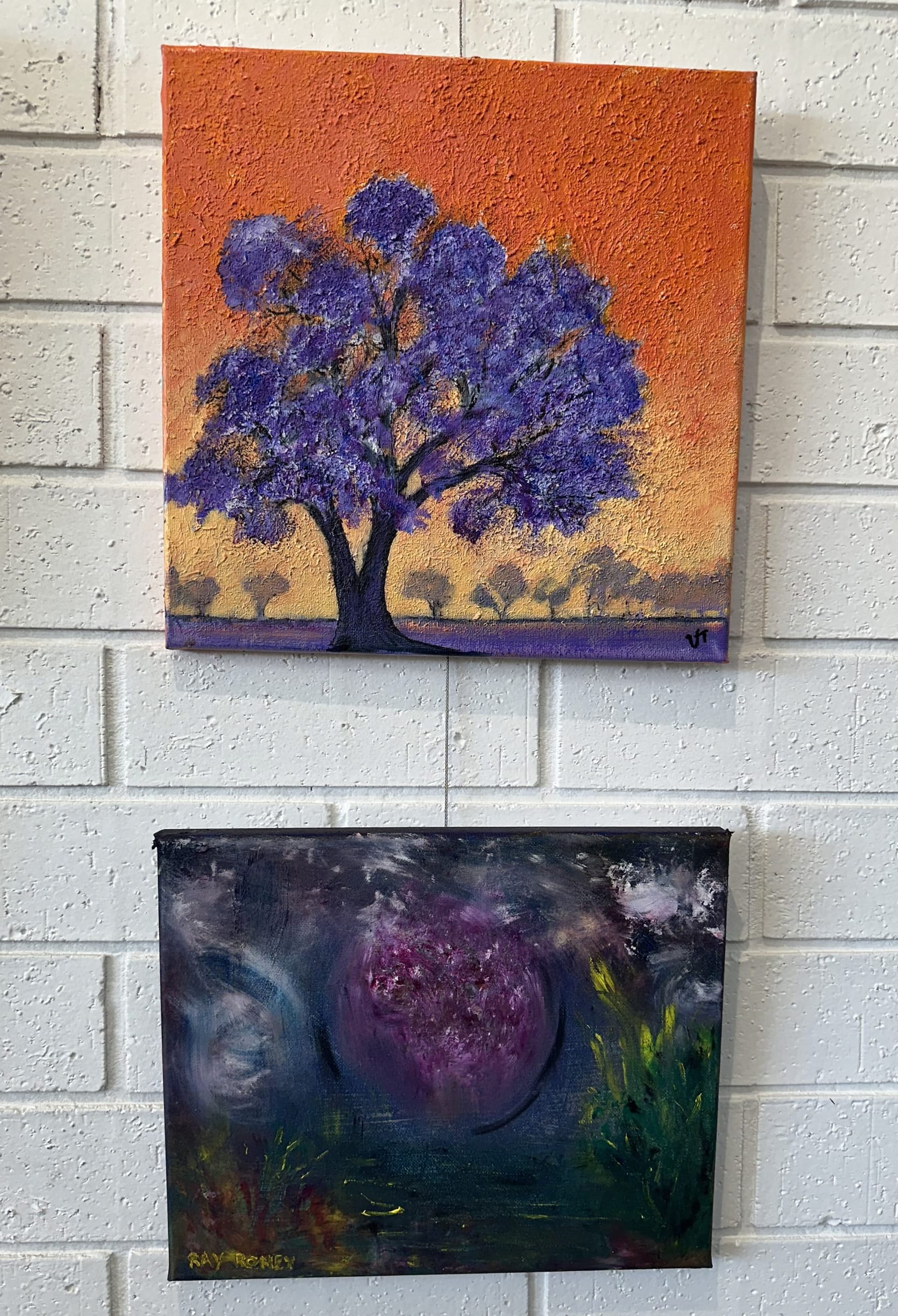
Ray Money’s Evolution was perhaps the most abstract of the works on show. Moody greens and blues surround a central purple, almost magenta, sphere, while tufts of white add movement across the surface. The manipulation of oil paint impressed the judges and Evolution was awarded for the Best Use of Medium.
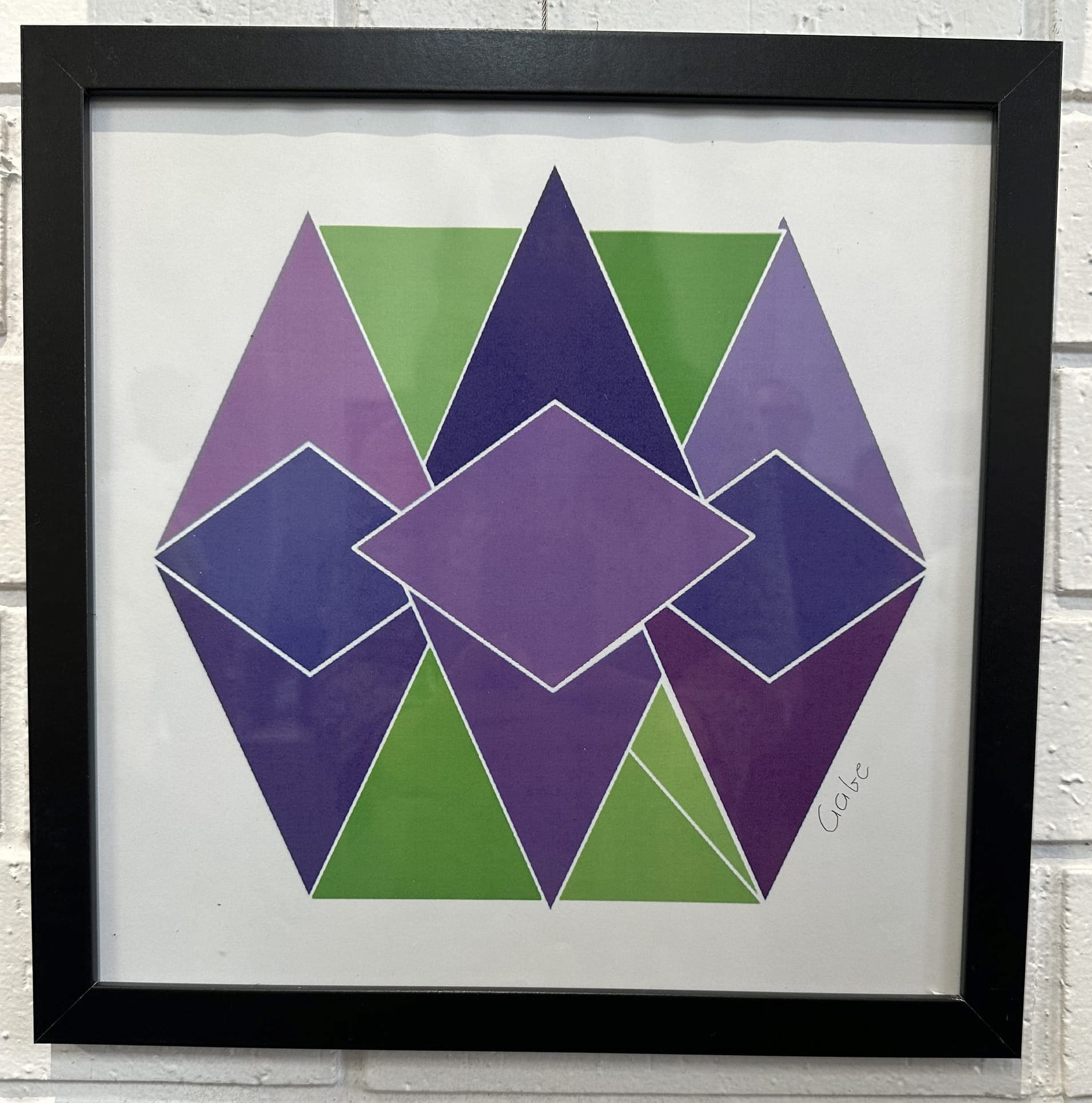
Abstraction also attracted entries from young artists, with Gabe Blundy winning the Nurture Award for Jacaranda Shapes, a work composed of diamonds in varying purple shades on a green and white background. Seemingly inspired by origami, Blundy has layered deceptively simple shapes together and where they overlap one another the eye is drawn around the space. I wondered what this configuration would look like unfolded.
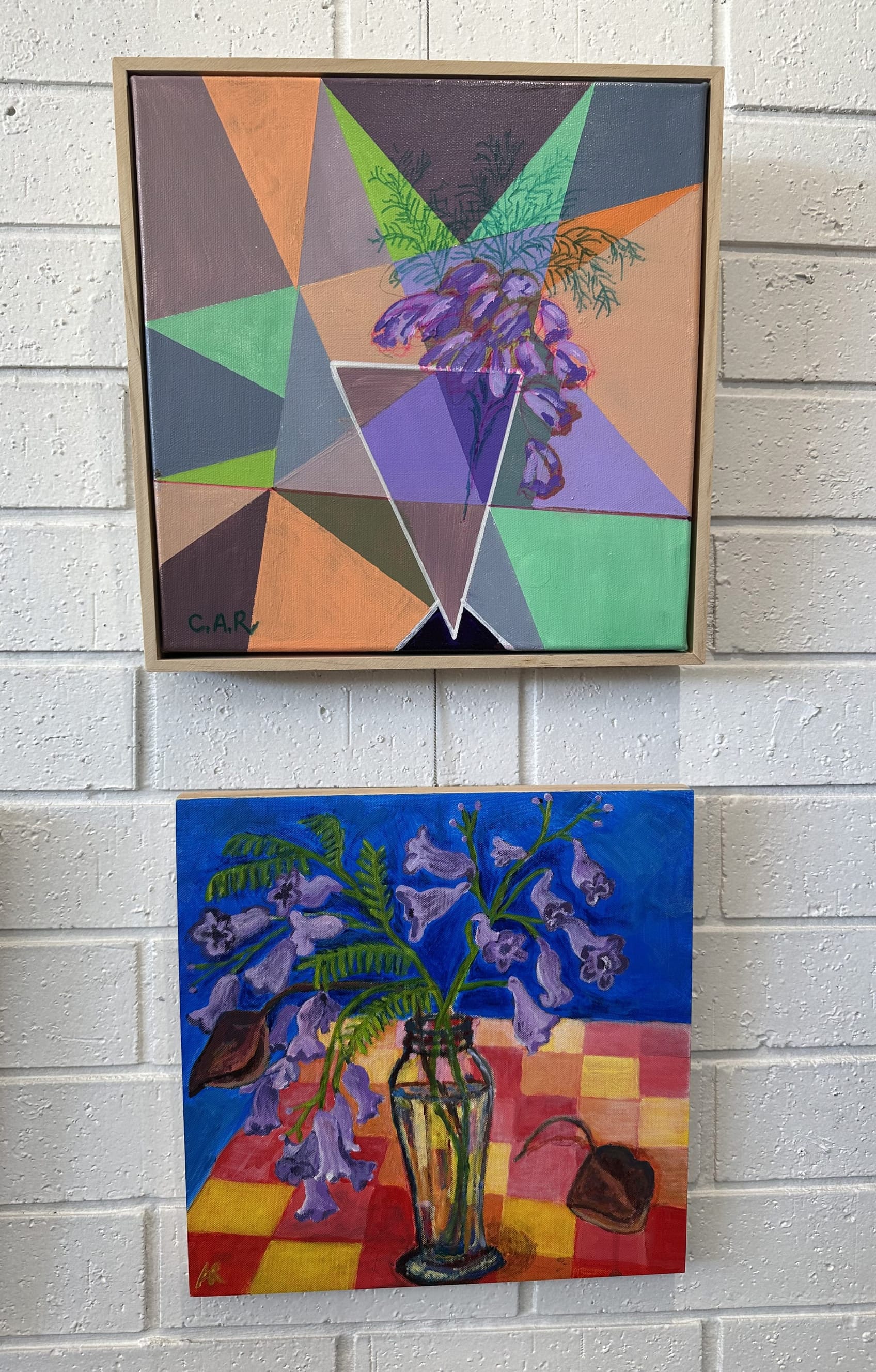
By restricting the subject and size but nothing else, the Jacaranda Art Prize creates fertile conditions of possibility to explore and experiment with a much-loved flower. The exhibition rewards looking slowly because it is filled with such varied interpretations and seeing such imagination on display is a genuine joy. Viewers are encouraged to vote for their favourite and the People’s Choice Award is announced on the final day of the exhibition, 23 January 2026.
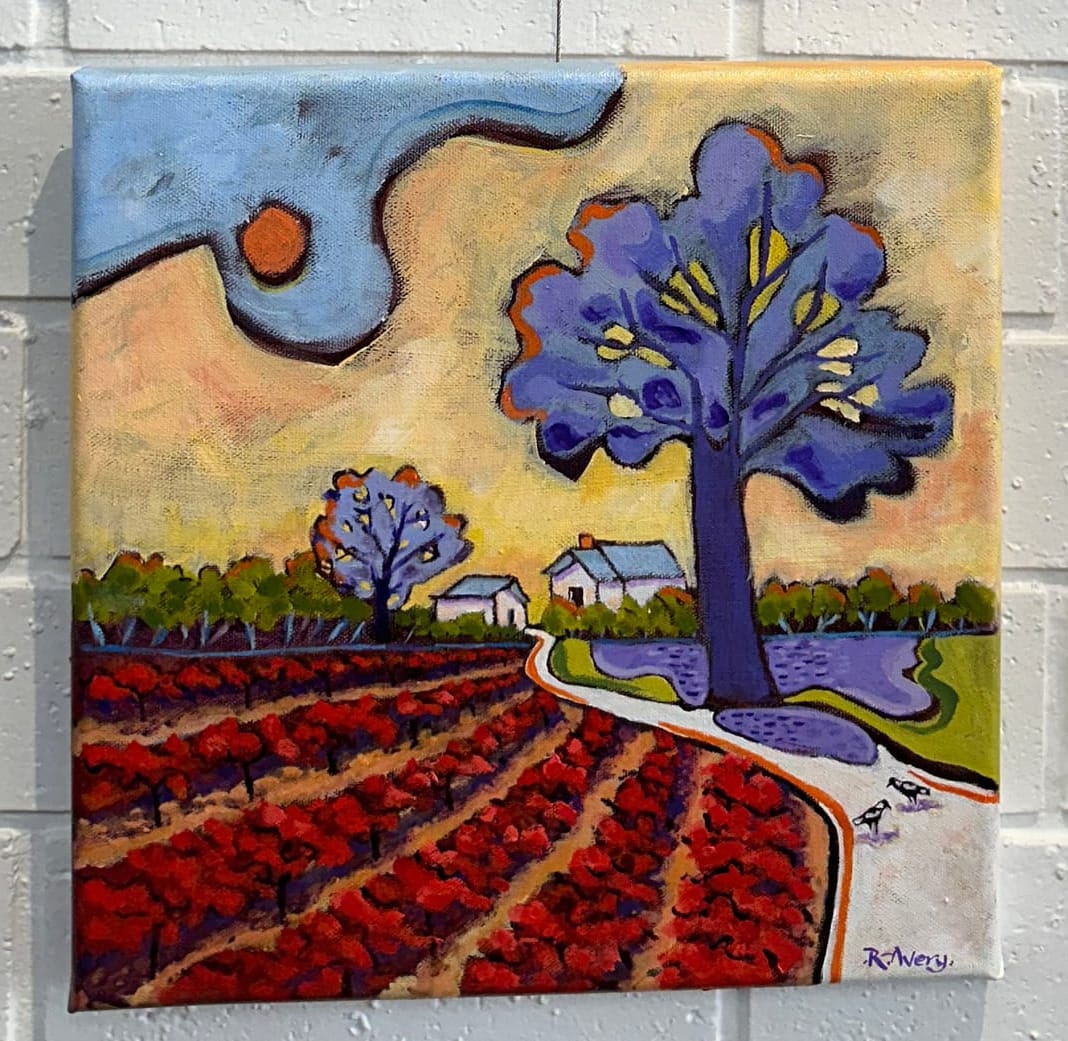
I voted for another work by Rhonda Avery. The Sentinel depicts a farm scene with one very large entirely purple tree in the mid-ground. The sky has an orange tinge and there are rows of vegetables next to a long winding driveway to a farmhouse. These elements suggest a location in Mildura, where dust storms turn the sky orange and symmetrical agriculture dominates the flat landscape. It also reminds me of a children’s book illustration, the execution is flat in places, it celebrates colour and small details, like the two magpies on the driveway, reveal personal connection to place.
Post script
- Offline, I have recently published some micro reviews in the fourth issue of Memo Reviews. These are fun to write and also a delight to read, like a Favourites chocolates of 2025 exhibitions, bite sized and sometimes the same exhibition is reviewed twice by different critics (here the analogy breaks down entirely, and it should be noted criticism isn't about sweetness, but never mind, just buy a copy!).
- You might have heard that Writers Victoria, along with the Abbotsford Convent have not had their multi year funding application rejected. The campaign to #savewritersvictoria is underway. Now is the time to purchase a one of their courses for the writer in your life, or a membership for yourself.
- Natasha Joyce has nailed the Adelaide Writers Week fiasco in the article for Lantana a new literary journal for our times.