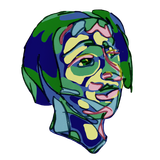
Josh Muir lives forever
I review First Nations artist Josh Muir, whose retrospective is touring Victoria.
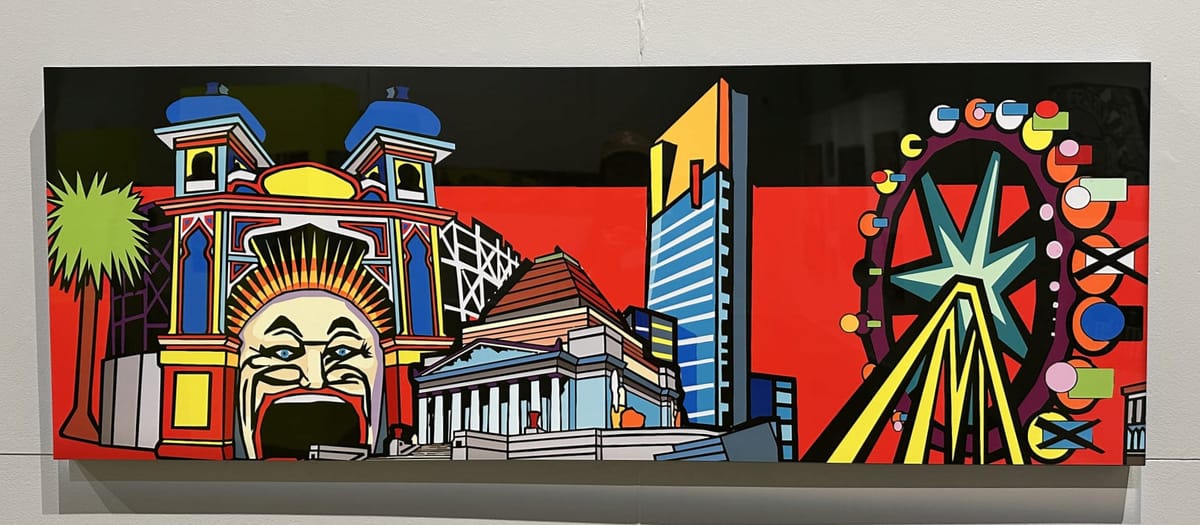
The bright, flat colours that Josh Muir uses in his digital prints might seem cartoonish, or reminiscent of street art—heavily pastiched, simplified—but this doesn’t mean the work is immature or undeveloped. Muir contends with nothing less than life and death and he uses self-portraiture as a vehicle for this.
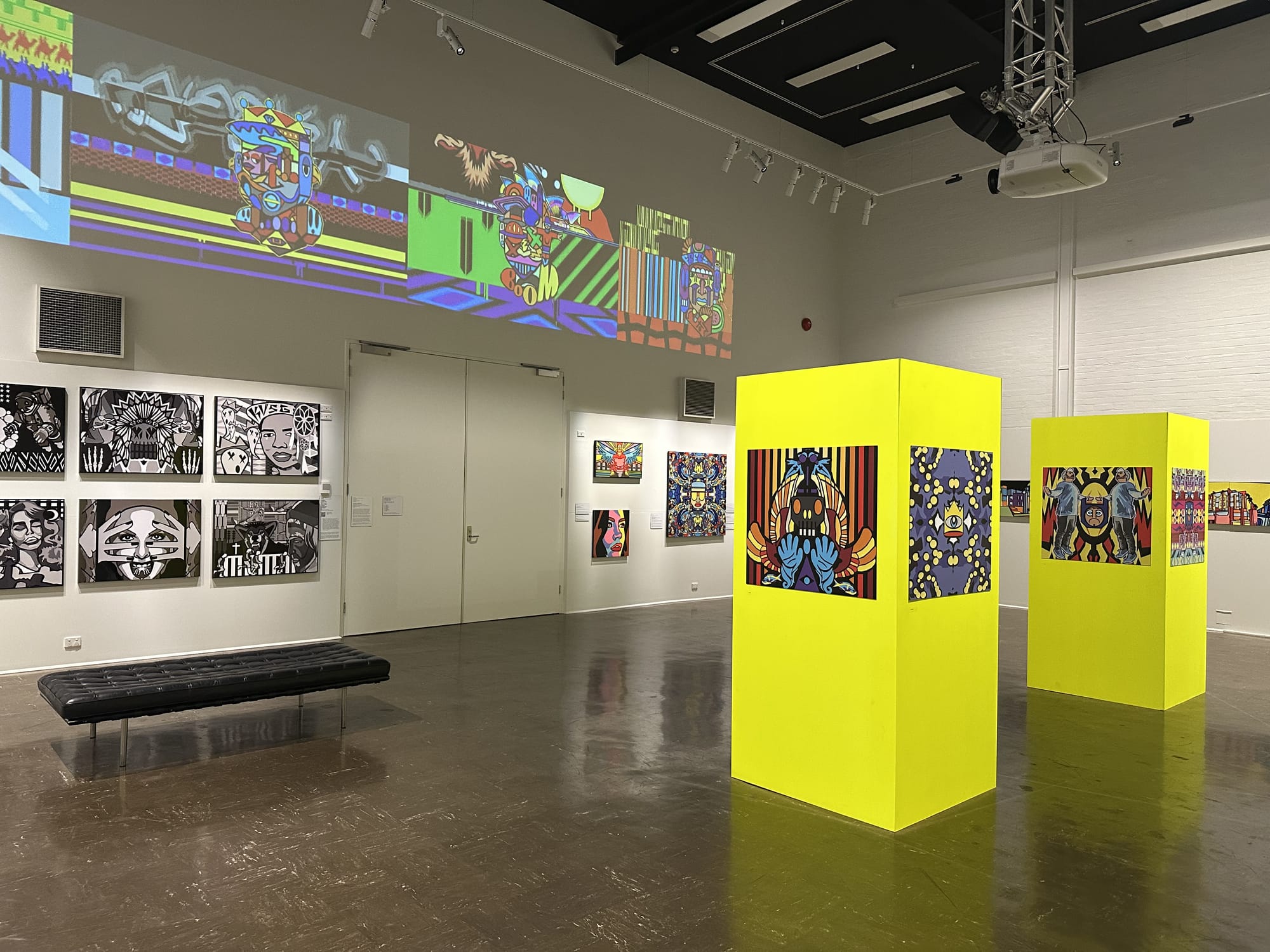
Music plays in the gallery space and I groove along with the beat. I’m not embarrassed to do so, there are only two other people in the space and one of them is the gallery attendant tapping away on a tablet. The artworks really only make sense with the music going. Their colours are best described as loud or bold and there’s heavy use of black to make certain colour combinations pop. It’s a mix of female vocals “keep on dreaming” and a male rapper with a strong, Aussie twang declaring “you’re the future”. Remixed specifically for the exhibition, the song is Bunjil’s Child by DJ Sadge (Dylan Clarke).
JXSH MVIR: Forever I Live is on display at the Mildura Arts Centre (MAC) until 3 May, a touring retrospective which honours the late Gunditjmara, Yorta Yorta, and Barkindji artist who passed away suddenly in 2022. Produced by the Koorie Heritage Trust (KHT), co-curated by Muir’s partner, Shanaya Sheridan, his mother, Justine Berg and the KHT curatorial team, MAC is the penultimate venue on the tour.
Muir was born in Ballarat on Wadawurrung country, a regional city not far from Melbourne, and his First Nations heritage connects him to three nations encompassing lands almost triangulating his birthplace: Gunditjmara country in the south west, Yorta Yorta lands in the north east and Barkindji country across the Murray and Barka Darling Rivers in far western New South Wales.
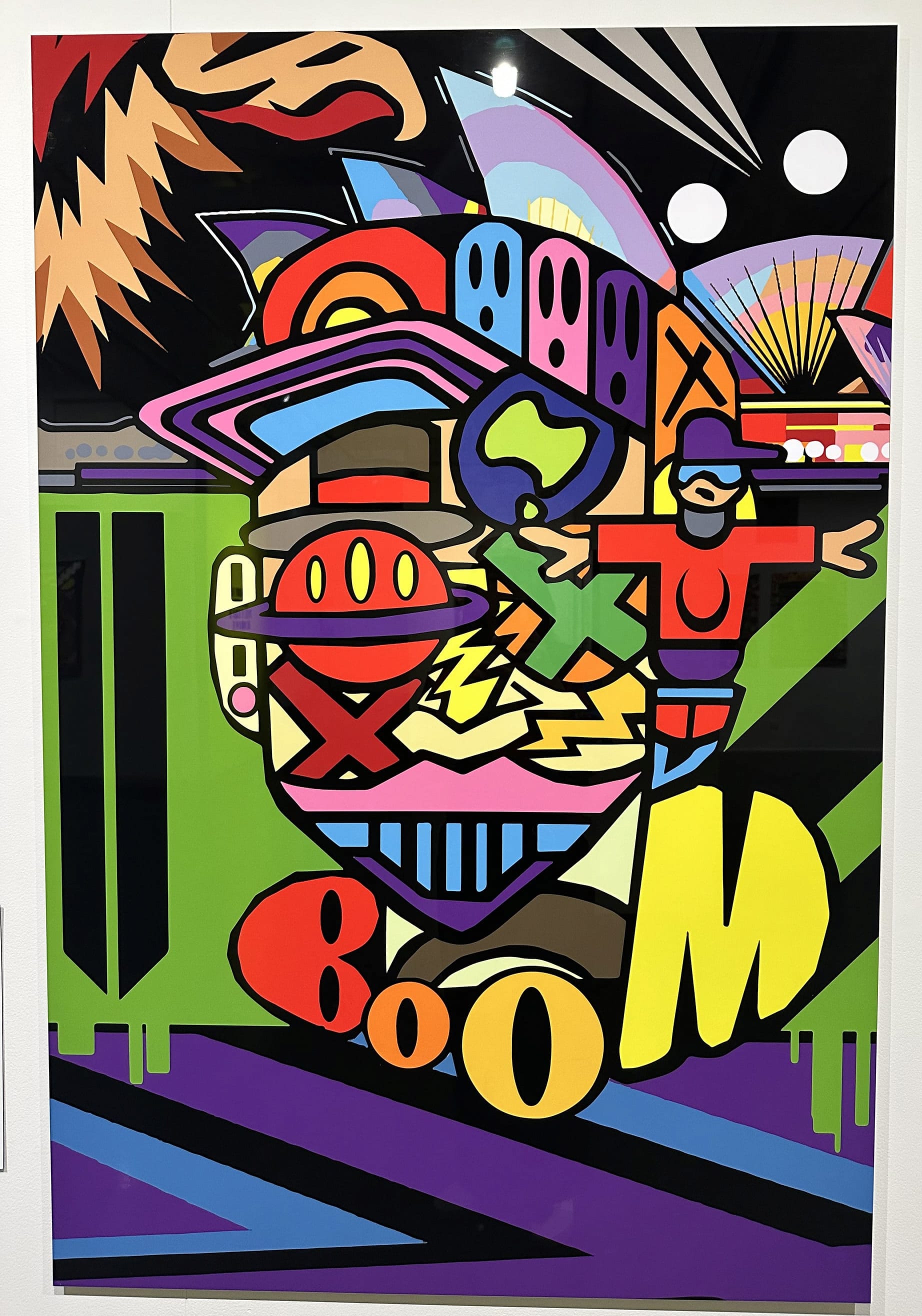
In a self-portrait series of 8 digital prints on aluminium, four of which are exhibited in this exhibition, the musical quality comes to the fore. In MOOB (2018) we see elements of a face, a baseball cap with the Sydney Opera house sails along the top, not unlike a mohawk. The face is composed of symbols slotted together, some are familiar (a top hat, a map of the country), others are strange (the planet Saturn with three yellow eyes?). A mini scarecrow-like man, also wearing a baseball cap, is positioned along the cheekbone and the word BOOM pulses under the figure’s head. Wet spray paint, flashing lights in the dark, a winged beast and a coffin are also present around the head, alongside lightning bolts and Xs. It’s busy and arresting and filled with the iconography Muir developed in his short career.
Next to this work is NOOM (2018) which might be my favourite for developing the surreal kaleidoscope of symbols and patterns into a self-portrait. Instead of a mouth, this figure has a beak and, on the bottom right, a foxlike creature is barking, could it be a dingo? Wings stretch out from the jaw bones of the figure whose gender is undiscernible beneath symbols of trees, which are also vertical direction arrows; circles, which are also eyes; crosses, which are also eyebrows; and skin, which is also a candle flame. In the background there are hot sunset colours in horizontal lines as well as slanted blue and white verticals which suggest water or a piano. This work reminds me of Canadian First Nations’ carvings and once again the music enhances its animated quality.
The figure in NOOM is built from a narrative involving animals, with the fox or dingo recalling Reg Mombasa’s trumpet dog and yet there are symbols and icons used in combination whose meaning eludes me. I don’t feel as though I’m locked out of the iconography though, even though the exact meaning is not clear to me. The works are both accessible to an audience not initiated into Muir’s world, and yet highly personal as well. This exhibition, as a retrospective, is an invitation to get to know his world.
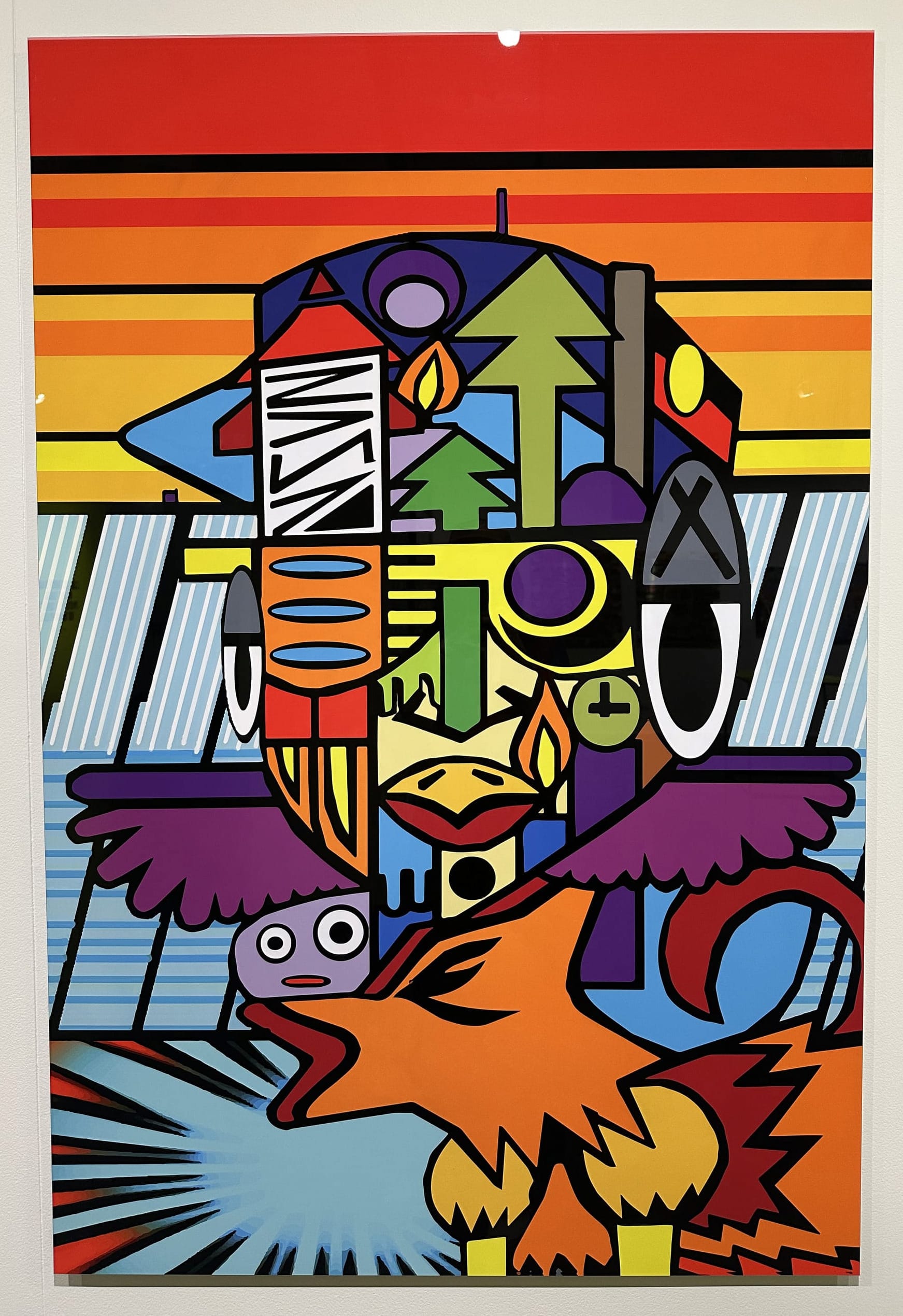
This work also introduces another icon connecting us to hip hop, America, and popular culture: a NASA rocket. Subtly disguised on the left of the figure’s face, the rocket makes the subject of this portrait explicit, the Moon, which has been reversed in the work’s title. The aspirational and transcendent beats reverberating through the exhibition serve to underscore this series of portraits all the more, I think. It’s joyful, appropriative, but also deeply connected to the lived realities of Indigenous youth.
The music is actually coming from Josh Muir Animated (DATE), a 3-channel video projected at the far end of the exhibition, high on the wall. Muir collaborated with Isabella Knowles on the animation and Dylan Clarke on the music. I stand below the linear wall projection and groove along for a while, noticing flashes of NOOM and MOOB.
Muir’s career took a huge leap with the development of his video works. For the 2016 White Night festival in Melbourne Still Here was projected onto the façade of the National Gallery Victoria (NGV), bluntly relaying the impact of colonisation on Aboriginal people from the perspective of an Aboriginal man in Victoria. Muir was 23 and the project led to his first solo exhibition at the Koorie Heritage Trust in 2018 Josh X Muir.
History and the impacts that have accrued from Australia’s colonisation weaves in and out of Muir’s artworks. The prospect of non-Aboriginal people living in a manner that didn’t harm Aboriginal people, one of the counterfactuals that we often can’t help trying to picture when learning the brutal details of the (even recent) past. This finds expression in a maquette of William Buckley. “Buckley’s chance” being an unfortunate phrase attached to the escaped convict who spent 32 years living with a tribe of the Wadawurrung people. Ironically, he survived because the Wadawurrung people took him in, thinking he was a returned ancestor. “Buckley’s chance”, therefore, seems like a racist phrase used to imply that a lack of hope is somehow attached to Aboriginal people. Muir’s work is intended to reverse this thinking.
In Muir’s sculpture of Buckley, he is wearing a possum skin cloak, carrying spears and boomerangs, his posture is relaxed and he’s looking to his left, not at the viewer. I think this leaves open the possibility of harmony, as Muir wanted it. If Buckley looked directly at the viewer, we might experience this as more threatening. Instead, he does not see us and is left to his own devices, becoming a powerful metaphor for the possibilities of cohabitation on Aboriginal land.
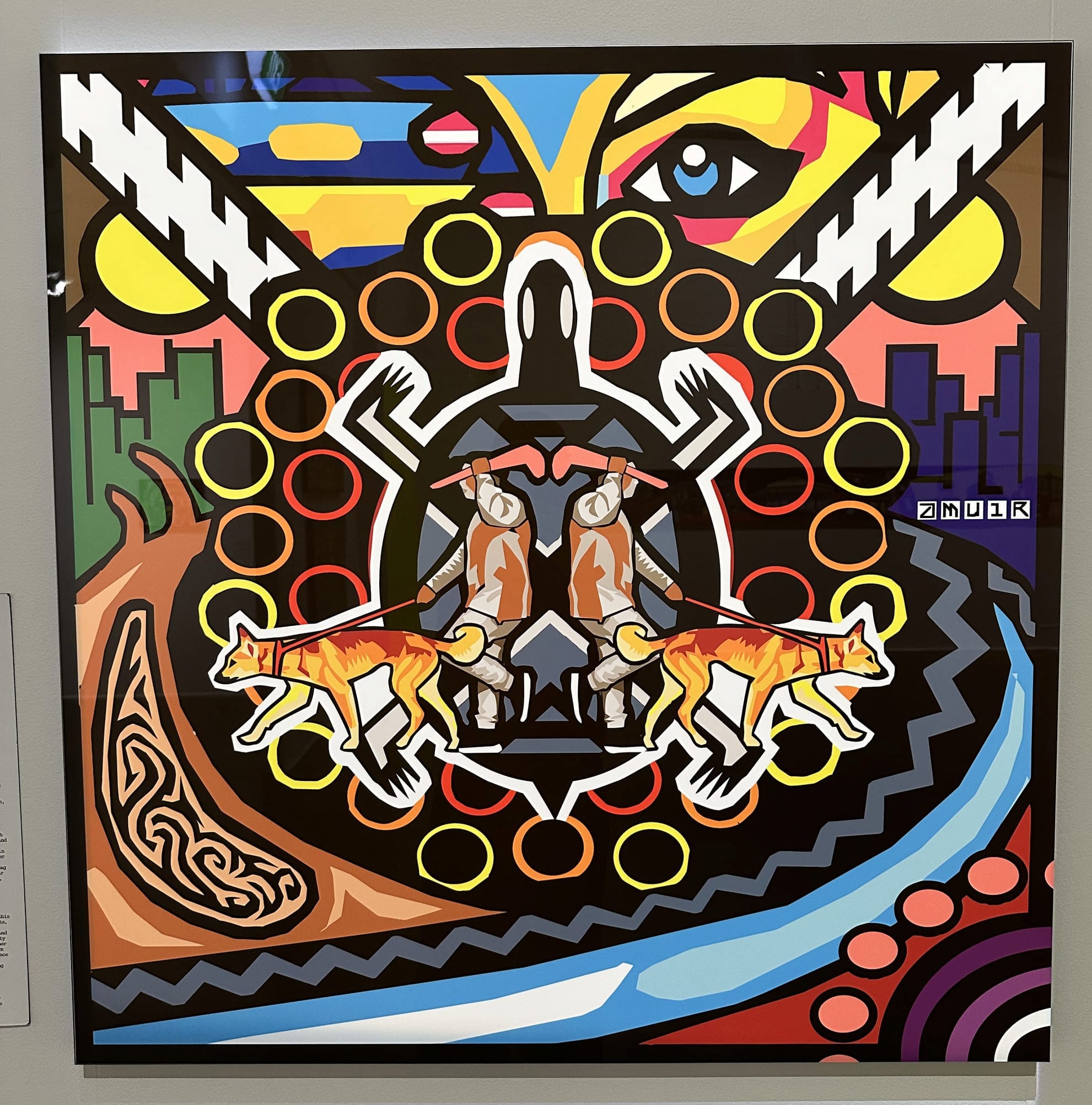
Survival is another theme treated to a sensitive exploration. In We Will Survive Muir includes his totem, the long neck turtle. He wrote:
The turtle totem wisdom teaches us about walking our path in peace and sticking to it with determination and serenity. Slow moving on earth, yet also incredibly fast and agile in water, those who have the turtle as totem may be encouraged to take a break in their busy lives and look around or within themselves for more grounded, long-lasting solutions.
Another iconographically dense depiction of identity, We Will Survive, is emblematic of both Muir’s layered approach as well as his generous spirit. There is much more to unpack here. I left the exhibition with a mix of feelings, including loss for the talent of an artist who was so committed to speaking truth to power in a manner that brought folk along with him. I left also feeling buoyed by the generosity of the exhibition—it is both intimate and hard hitting, allowing for the challenges and consequences of colonisation that Aboriginal people face on a daily basis—while embracing the potential of multiple different art forms for healing.
Post Script
I have two publications I would like to share with you all, and one reminder which might be of interest.
- I have a chapter published in Legacies of British Slavery in Australia and New Zealand which is the product of a post-doctoral project with the fantastic historians Zoe Laidlaw and Jane Lydon among others in this collection, which is a must read. I suggest you request you library to order a copy because it is not accessibly priced.
This book investigates the legacies of British slavery beyond Britain, focusing upon the colonisation of Australia and New Zealand, and explores why this history has been overlooked. After August 1833, when the British Parliament abolished slavery in the British Caribbean, Mauritius and the Cape, the former slave-owners were paid compensation for the loss of their ‘property’. New research has begun to show that many beneficiaries had ties to other parts of the British Empire, including the settler colonies of Australia, New Zealand, Canada and South Africa. Through a range of case studies, contributors to this collection trace the movement of people, goods, capital, and practices from the Caribbean to the new Australasian settler colonies. Chapters consider a range of places, people and themes to reveal the varied ways that slavery continued to shape imperial relationships, economic networks, and racial labour regimes after 1833.
- My review of Yarra Birrarung: Artists, Writers and the River has been published on the Professional Historians Australia website. If you love history books that are primary source dense, this is one for you.
- Finally, April 11 is Slow Art Day. A gallery near you might be holding an event where you can sit with other humans, look for a while at art and even do a bit of drawing.
I mention this because of how important I believe it is to look at art in person, and often when there are other humans with you, you'll be surprised by what emerges.
As always, if you've enjoyed this review, please share with your friends. We don't see enough criticism like this popping up in national arts pages, but that doesn't mean it doesn't exist in other places.