Being unsettled
It’s not just curiosity about my own tastes that drives this newsletter endeavour, I’m also doggedly of the conviction that looking at things slowly – avoiding fast, easy conclusions – is an important and valuable thing to do in and of itself.
It’s not just curiosity about my own tastes that drives this newsletter endeavour, I’m also doggedly of the conviction that looking at things slowly – avoiding fast, easy conclusions – is an important and valuable thing to do in and of itself.
Looking beyond art, though, other things also sustain my gaze, and one of them – colonialism – rewards ongoing looking with knotty questions, existential dilemmas and controversies (which also pop up in this newsletter from time to time). Here is a review of a book not about Australia’s colonisation, but somewhere quite similar.
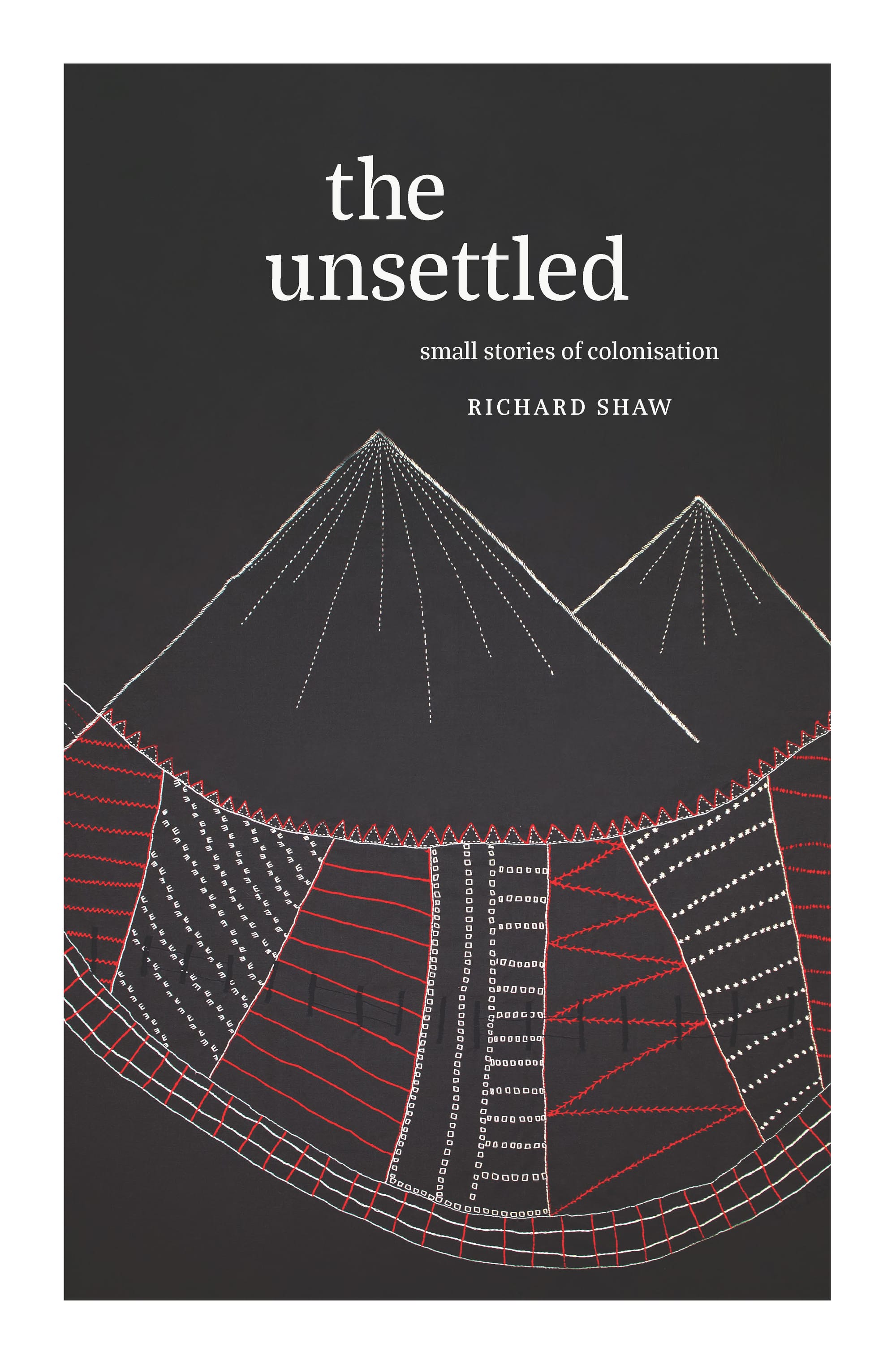
The village of Parihaka, established in 1866 near Taranaki on Aotearoa New Zealand’s north island, was home to displaced Māori. Two esteemed leaders (rangatira) Te Whiti o Rongomai and Tohu Kākahi, had established Parihaka as a site of non-violent resistance during the New Zealand Wars. On 5 November 1881 a militia of 1588 men, including Andrew Gilhooly—an Irishman who joined the armed constabulary in 1877—invaded the Pa (or village) and destroyed people’s homes and their crops. This description doesn’t describe the events accurately; they have been called one of the darkest moments in Aotearoa’s history.
Later Gilhooly would return to farm some of the same confiscated land in the 1890s, allowing his family to prosper beyond what was possible for them had they remained in Ireland as tenant farmers. These are the observations of Gilhooly’s great-grandson, Richard Shaw, in his book The Unsettled: small histories of colonisation. Published in 2024, it explores the types of stories that collectively justify national narratives of occupation, namely of leaving one place and coming to another to make a better life.
Family history is central to Shaw’s approach which draws upon this often denigrated but booming genre of history writing. Genealogy has been the most popular form of history in Australia for some time now. The question of just how settler-descendants comprehend the benefits they’ve accrued from the dispossession of Indigenous peoples has also been asked in a number of ways. Australian history is well contested, secondary and tertiary courses are framed around difficult histories; the more controversial the more students are thought to enrol. Recently the question of family ties to the legacies of British slavery arose in the wake of research allowing any individual to search their family name in a database of slave owners. On a recent trip to Aotearoa I picked up a copy of The Unsettled: small histories of colonisation, which presents multiple family histories and their connections to invasion. Its equivalent in Australia might be Henry Reynolds’ 1999 pathbreaking Why weren’t we told in which he documents his awakening understanding of the true history of our continent and its cover up. Kate Grenville’s The Secret River treads similar ground from a different methodological vantage point.
Richard Shaw is the sort of guide you want for the uncomfortable task of reckoning with difficult personal histories in Aotearoa. He is a Pakeha (non-Māori) professor of politics at Massey University, he also wrote a memoir about racism, the Catholic church and fathers titled The Forgotten Coast in 2021, which set in motion an unexpected tide of correspondence leading to this book. In the course of writing he uncovered disturbing connections between his great-grandfather and the invasion of Parihaka. Many people wrote to Shaw about how their own ancestors had participated in taking Māori land and the result is an explanation of these histories on a personal scale.
This is a conversational book, it’s designed to be accessible, or at least I found it so, and it’s composed in large part from conversations between Shaw and named/unnamed interlocutors reflecting on the “why weren’t we told” of Aotearoa’s colonisation. The interviewees aren’t writers or academics, but they have lived full and interesting lives and now reflect on their path to the present.
The whole point of the book seems to be regular people coming to terms with their ambivalent inheritance.
Perhaps this is why I found Shaw a particularly apt guide and the book overall refreshing and necessary. I did think often of what such an account would look like in the Australian context. Though Australia and New Zealand’s two examples of settler colonialism diverge, the theft of Indigenous land remains the overwhelming reason our countries have become what they are, for better and worse. Dispossession is at the root of the family trees Shaw examines in this book and he intends not to look away from the disturbing things he sees.
While Parihaka and its legacy informs the book, the focus isn’t on Maori passive resistance or their perspectives. Rachel Buchanan’s The Parihaka Album does this. And an earlier book Ask That Mountain by Dick Scott outlines the truer history.
Shaw’s ancestors ran three farms on the north island of Aotearoa which he argues “enabled them to break with centuries of Irish penury and reinvent themselves as settlers, members of a tightly knit coastal Taranaki community that orbited around the Catholic church and the family farm” (16). Until relatively recently it was accepted that such a turn of events was neutral, as though Māori and indigenous peoples everywhere didn’t oppose invasion, or if they did, they were subdued through completely justifiable processes of civilisation.
Digging up the unsavoury parts of their family histories requires this book’s contributors to take a long hard look at themselves as well as where they came from. The crux of this inheritance, which the book reveals in interwoven snippets is that a new way of seeing the past is possible. The South Road to Taranaki can no longer be viewed as just a road. The lighthouse and the telegraph are no longer neutral. Shaw now understands their purpose was to facilitate the invasion of Parihaka. Roads become just one example of previously inert infrastructure seen anew. The point for Shaw and his interlocutors is to find a way to come to terms with this past that doesn’t replicate previous practices of forgetting and denial.
While this doesn’t take the form of a guide, the interviews in the book do give the direct experiences of people contending with and reflecting on this history. We see their processing in real time and that is just as useful.
Backlash against this project is also narrated in the book. Opposition to the task of reckoning with the past on a personal level has been called attacks on the dead, in line with a pervasive view that pushes First Nations people to “move on”. The pakeha in this book are determined to take some of this flak. One of Shaw’s interviewees, John, explains that it should be possible to talk about what his Pakeha ancestors did without blaming them. In Aotearoa public opinion refuses to accept this important distinction and a section of the book is dedicated to unpacking how non-Indigenous folks can practice decolonising.
“I cannot deduce my great-grandfather’s intent (or views on empire, Māori or anything else) from my contemporary understanding of the momentous happenings he was party to, anymore than I can sensibly hold him responsible for all that colonisation has visited upon tangata whenua” (people of the land) (88).
Across the ditch, we call this the Great Australian Silence, from a 1968 lecture by anthropologist W.E.H Stanner. He spent time with First Nations people and then pointed out to a non-Indigenous audience what had been apparent for many years: Australians had chosen to forget the premise on which their country was built and instead substitute their own myth of hard work and a fair go. (That this fair go did not extend to non-white people seemed to matter little.) The Unsettled explores the not knowing, the un remembering and the revelations that come with sanding back the whitewash.
Shaw writes, “in my case, not remembering meant that for 50 years I got to avoid having to confront the fact that my family shucked off its Irish tenant farmer identity and remade itself as a settler-colonial family on the basis of land that had been taken from other people” (92).
Chapters on how the forgetting happened are followed by the processes of digging up the past, understanding what it is to benefit from injustice and a concluding section with thoughtful suggestions about what to do next. Much of this will be familiar to students of decolonisation and the steps that Shaw describes are small, but they are also extremely meaningful in the context of a political climate that shies away from bearing witness to difficult histories. He writes, “It requires taking a public position on the matter of this country’s understanding of itself; more than that, it means we need to step into the political maelstrom in a direct and personal way. Bearing witness is a decidedly active thing to do" (169).
I’m looking forward to seeing, if there is a sequel to The Unsettled, what correspondence arose in its wake.